
Vice President Hussain Mohamed Latheef has highlighted the Maldives’ ambition to become a developed country by 2040, stressing that greater access to climate finance, affordable development financing and stronger international support for Small Island Developing States will be essential to achieving the country’s long-term national development goals.
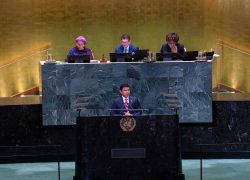
Addressing the 81st session of the United Nations General Assembly, the Vice President said President Dr Mohamed Muizzu had established a clear national ambition for the Maldives to reach developed-country status by 2040, supported by policies aimed at strengthening productivity, diversifying the economy, developing resilient infrastructure, expanding renewable energy and investing in the capabilities of Maldivians.
“Our future will be built by Maldivians,” Vice President Latheef said, underscoring the government’s emphasis on strengthening national capacity and creating an economy capable of generating sustainable opportunities for future generations.
The Vice President presented the 2040 target as a comprehensive national development agenda that will require continued investment across infrastructure, human capital, technology, energy and emerging economic sectors. For the Maldives, he said, achieving greater economic resilience will also depend on the international environment providing vulnerable countries with sufficient financial and technological space to pursue their national priorities.
He said technology transfer, resilient supply chains and accessible financing could expand the development choices available to countries such as the Maldives, while technological dependence, external economic shocks and unsustainable debt could significantly constrain those choices.
The Vice President placed climate finance at the centre of this discussion, noting that climate change remains one of the most consequential challenges affecting the ability of Small Island Developing States to determine their future development pathways.
For low-lying island countries such as the Maldives, sea-level rise is increasingly connected not only to environmental protection but also to long-term national planning, infrastructure development, economic security, livelihoods and the sustainability of communities across dispersed islands.
“Resilience demands the means to act,” the Vice President said, calling for climate finance to reach vulnerable countries at the scale and speed required to translate international commitments into practical resilience projects.
He emphasised that financing for SIDS should be predictable and accessible, with greater availability of grants and highly concessional resources. Such financing would provide vulnerable economies with greater capacity to invest in climate-resilient infrastructure and adaptation without adding unsustainable financial pressures.
The Maldives has consistently highlighted the particular development challenges faced by small island economies, including geographic dispersion, limited economies of scale, vulnerability to climate impacts and exposure to external economic shocks. These structural characteristics can create significant financing requirements even as countries make progress under conventional economic indicators.
Against this background, the government has continued to advocate for reforms to the international financial architecture and improved access to affordable financing that better reflects the vulnerabilities of Small Island Developing States.
Vice President Latheef said the Maldives’ development ambitions should therefore be accompanied by meaningful progress in the international financing system, including implementation of the Sevilla Commitment and its provisions relating to development finance, debt sustainability and reform of the global financial architecture.
He also highlighted the Borrowers’ Platform, launched earlier this year with the participation of developing countries including the Maldives. The initiative provides borrowing countries with a dedicated platform to exchange experience, strengthen technical cooperation and contribute more effectively to international discussions on debt and development financing.
The Vice President said such mechanisms should develop into lasting platforms that strengthen the voice of developing economies in shaping an international financial system that is more responsive to their development circumstances.
For the Maldives and other SIDS, greater national agency also requires continued reforms and investment at home, he said.
“We must build our institutions, improve stability, and attract responsible investment and meaningful partnerships,” Vice President Latheef said.
He emphasised that international partnerships should strengthen the capabilities of countries and contribute directly to national priorities instead of creating new forms of dependence.
The Vice President linked this principle with President Muizzu’s “Maldives First” policy, describing an approach to international engagement centred on national interests, mutual respect and partnerships that contribute positively to the Maldives and its people.
Under the government’s longer-term development vision, economic diversification is expected to play an important role in increasing resilience and creating new opportunities beyond the country’s established economic sectors. Strengthening infrastructure, improving the investment environment, expanding renewable energy, developing technology-driven industries and investing in Maldivian talent are among the areas being pursued as part of the broader national transformation agenda.
The government’s development strategy also places importance on strengthening the country’s capacity to withstand external disruptions. As a geographically dispersed island nation closely connected to international trade, tourism, transport and financial markets, greater domestic resilience is considered essential to maintaining sustainable economic progress.
Vice President Latheef said the same principle of national capacity should guide global climate cooperation.
For the Maldives and other low-lying island nations, rising sea levels have potentially far-reaching implications for infrastructure, economic activity, communities and livelihoods. Adaptation therefore requires substantial and sustained investment in areas including coastal protection, resilient infrastructure, water security, energy systems and community resilience.
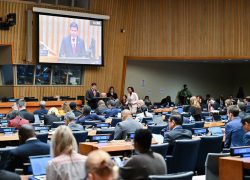
During a separate address at the United Nations on sea-level rise, the Vice President similarly called for adaptation financing to be predictable, accessible and delivered more rapidly, with grants and highly concessional financing playing a stronger role for vulnerable countries.
His remarks reinforce the Maldives’ longstanding position that international climate commitments must be translated into financing that countries can practically access and deploy.
At the General Assembly, the Vice President also called for faster progress towards the 2030 Agenda for Sustainable Development and measurable implementation of the Antigua and Barbuda Agenda for SIDS, which provides an international framework for supporting the sustainable development priorities of small island states.
Looking ahead to COP31 in Antalya, Türkiye, he said the international climate conference must focus strongly on delivery and implementation, ensuring that commitments produce measurable benefits for countries facing some of the greatest climate risks.
“Global commitments matter only when they enable progress at home,” the Vice President said.
For the Maldives, this means ensuring that international cooperation supports national development priorities while strengthening the country’s ability to respond to climate impacts and economic shocks.
Vice President Latheef also highlighted the growing importance of artificial intelligence, technological advancement and technology transfer in determining the development opportunities available to smaller economies. Access to modern technology, knowledge and resilient supply chains can enable countries to raise productivity, develop new industries and participate more competitively in the global economy.
Combined with accessible financing, such opportunities could provide the Maldives with additional pathways towards economic diversification and higher-value growth as the country progresses towards its 2040 development objective.
The Vice President’s address positioned national development and sovereignty as closely connected for Small Island Developing States, with stronger domestic institutions supported by an international system that provides countries with the financial and technological tools necessary to determine their development priorities.
“Partnerships must serve national needs, strengthen what we have and leave us more capable than before,” he said.
The government’s 2040 ambition therefore represents more than an economic classification target. It reflects a broader vision of a more productive, diversified, resilient and technologically capable Maldives supported by stronger institutions, modern infrastructure, renewable energy development and greater opportunities for Maldivians.
At the international level, the Maldives is seeking an enabling financial environment in which vulnerable island states are able to access climate and development resources on terms that allow them to invest in their future without compromising long-term economic sustainability.
The Vice President’s message at the United Nations placed the Maldives’ national ambitions within that wider global discussion, calling for international partnerships and financing arrangements that enable small states to strengthen their capabilities, protect their communities and independently shape their development trajectory.
As the Maldives advances towards its 2040 target, the government’s emphasis remains on combining domestic reform and investment with constructive international cooperation, allowing the country to pursue higher productivity, stronger economic resilience and sustainable development while ensuring that Maldivians remain at the centre of the nation’s future.
 advertisment



 advertisment