
Vice President Hussain Mohamed Latheef has called for stronger and more coordinated international action to address the growing threat of sea level rise, stressing that vulnerable island nations such as the Maldives must be supported in building long-term resilience rather than being forced to retreat from the effects of climate change.
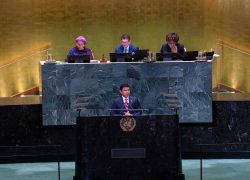
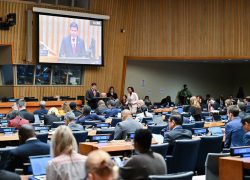
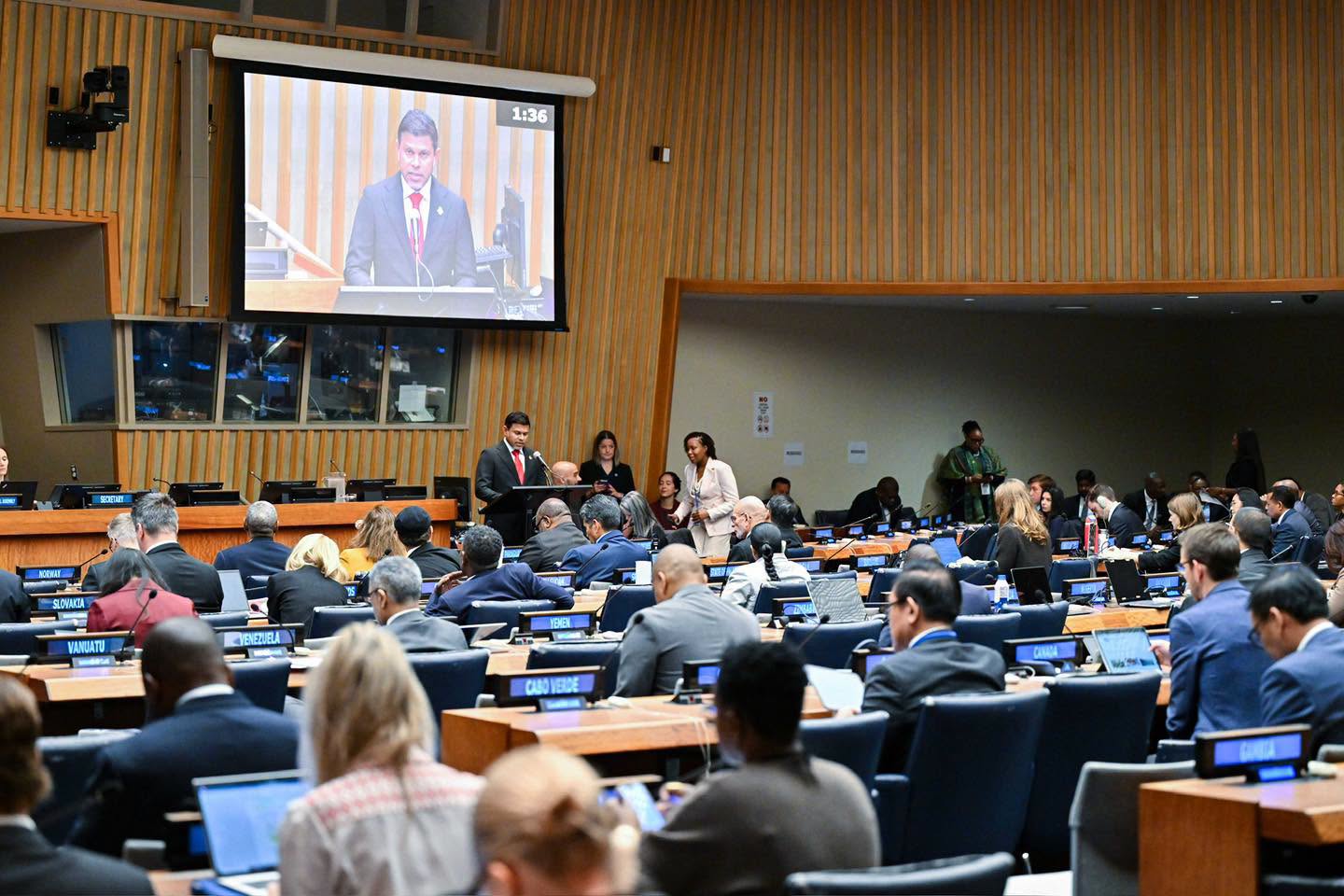
Speaking at the High-Level Plenary Meeting on Addressing the Existential Threats Posed by Sea Level Rise during the 81st Session of the United Nations General Assembly in New York on Thursday, the Vice President presented the Maldives’ position on one of the most significant challenges facing Small Island Developing States. The high-level meeting brought together international leaders and stakeholders to strengthen cooperation and advance practical responses to the increasing risks associated with rising sea levels.
Vice President Latheef said the Maldives had been drawing international attention to the dangers of rising seas for nearly four decades, reflecting the country’s longstanding leadership in global climate advocacy. He recalled that the Maldives convened small island states in Malé in 1989, resulting in the adoption of the Malé Declaration on Global Warming and Sea Level Rise, at a time when the issue had yet to receive the level of international attention it commands today.
He said the concerns raised by the Maldives decades ago have become increasingly urgent as climate-related pressures threaten infrastructure, tourism, fisheries, ecosystems, livelihoods and the wider development prospects of Small Island Developing States. For a geographically dispersed and low-lying island nation such as the Maldives, strengthening resilience remains closely connected to protecting communities, sustaining economic activity and preserving development gains for future generations.
Highlighting the Government’s approach to confronting these challenges, the Vice President identified three areas requiring greater international attention: financing climate adaptation at sufficient scale, strengthening legal protections for countries affected by sea level rise, and incorporating resilience more comprehensively into national development and economic planning.
On climate finance, Vice President Latheef called for international adaptation funding available to Small Island Developing States to become more predictable, accessible and responsive to their specific circumstances. He stressed that support should primarily be grant-based or provided on highly concessional terms, recognising the financial constraints faced by vulnerable island economies as they invest simultaneously in development and climate resilience.
He further emphasised that access to financing must become faster and simpler. Climate finance, he said, should reach vulnerable countries early enough to enable governments to reduce exposure and strengthen infrastructure before climate-related damage occurs, rather than primarily becoming available after countries have already suffered significant losses.
For the Maldives, such financing can play an important role in supporting long-term investments in resilient infrastructure, coastal protection, essential public services and economic sectors that are particularly exposed to environmental risks. Expanding access to affordable international climate finance would also allow vulnerable countries to pursue adaptation measures without placing excessive additional pressure on national finances.
The Vice President additionally called for the establishment of a dedicated mechanism to systematically observe and monitor sea level rise. Reliable scientific data and continuous monitoring, he indicated, are essential for governments and international institutions to understand evolving risks, develop effective policies and direct investments towards communities and infrastructure facing the greatest exposure.
Addressing the legal implications of rising seas, Vice President Latheef stressed that physical changes resulting from sea level rise should not undermine countries’ internationally recognised rights. He said lawful baselines, maritime zones and state entitlements must remain protected even as coastlines and geographical conditions change because of climate impacts.
He also underlined the importance of preserving statehood, sovereignty and membership of the international community regardless of changes to physical geography. The position reflects the Maldives’ wider advocacy for greater legal certainty for low-lying island states facing circumstances in which climate change could alter coastlines while their political, sovereign and legal identities remain unchanged.
The Vice President also called for climate resilience to become an integral part of national development planning rather than being treated as a separate environmental consideration. He highlighted the importance of incorporating resilience into infrastructure development, economic strategies and longer-term national planning so that investments made today remain sustainable under future climate conditions.
He said the Maldives is already pursuing this approach through its third Nationally Determined Contribution, while calling on development partners and the wider international community to support the country in expanding and accelerating resilience investments. The Government’s approach places adaptation alongside national development priorities, reflecting the importance of protecting inhabited islands, public infrastructure and key sectors of the economy while continuing to improve services and opportunities for communities.
The Maldives has continued to maintain a prominent international voice on climate change and issues affecting Small Island Developing States during the 81st UN General Assembly. During his visit to New York, Vice President Latheef has also highlighted climate resilience, debt sustainability, implementation of the Antigua and Barbuda Agenda for SIDS and broader development priorities in engagements with international partners.
Concluding his statement, Vice President Latheef called for sustained international attention to the threats posed by sea level rise and urged countries and development partners to translate existing international commitments into practical measures. He stressed the importance of strengthening resilience now to protect communities, national development and the interests of future generations.
The Maldives’ message at the UN reinforces the Government’s continued emphasis on practical climate adaptation, international cooperation and stronger financial and legal frameworks for vulnerable island states. As one of the countries most directly exposed to rising seas, the Maldives continues to advocate for solutions that allow island nations to remain resilient, economically sustainable and secure while pursuing their long-term development ambitions.
 advertisment



 advertisment