
The Maldives Monetary Authority (MMA) has updated the deadline for mandatory foreign currency conversions under the Foreign Currency Act, introducing a significantly shorter compliance timeline for resorts, tourism establishments and other businesses covered by the legislation.
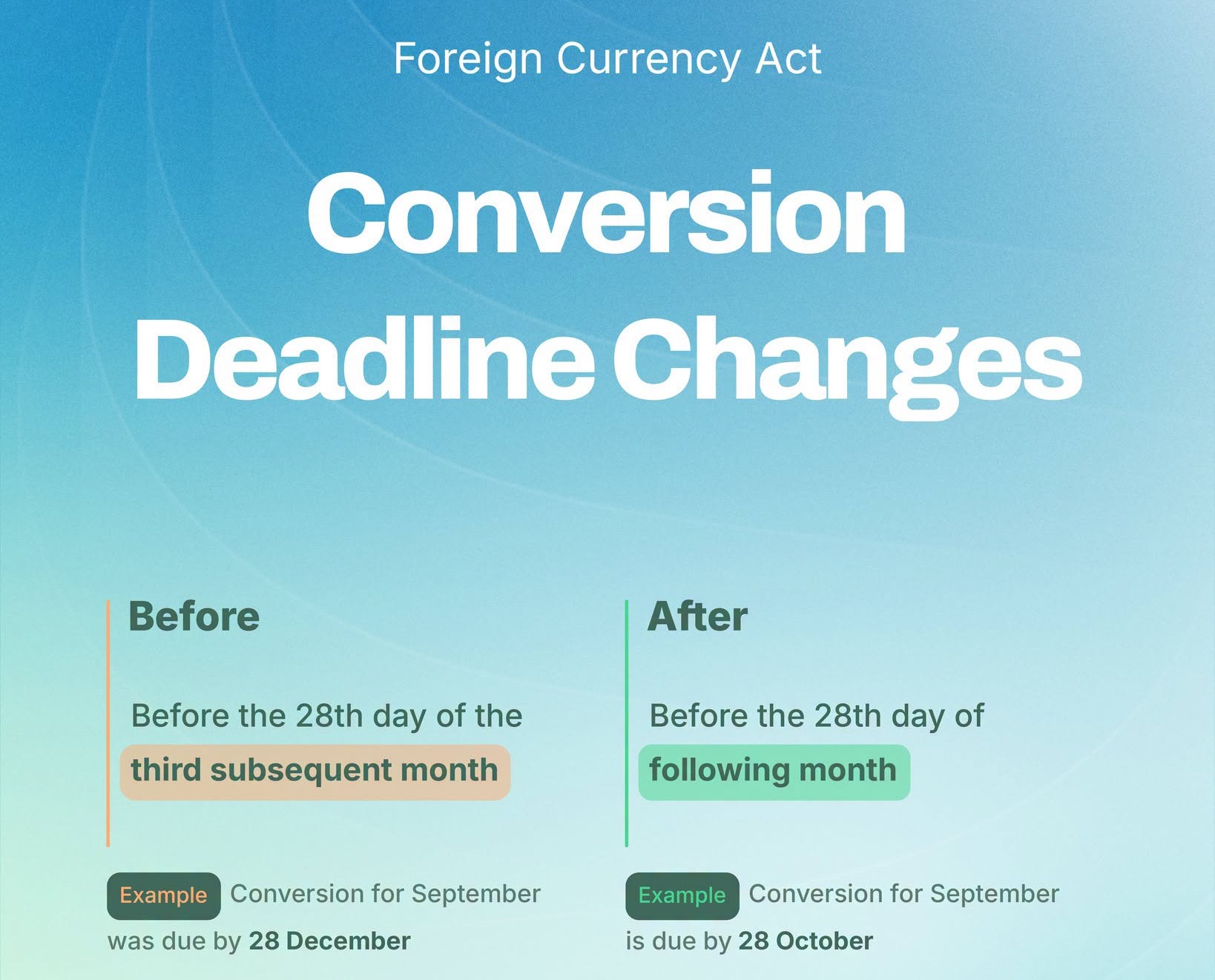
Under the revised framework, foreign currency required to be converted through the domestic banking system must now be converted by the 28th day of the month immediately following the month in which the relevant sales were generated. Previously, businesses were permitted to complete the required conversion by the 28th day of the third subsequent month.
The change means businesses will need to complete their foreign currency conversions two months earlier than under the previous timeline. For example, the required conversion relating to foreign currency sales generated during September 2026 must be completed by 28 October 2026. Under the previous arrangement, the corresponding deadline would have been 28 December 2026.
The revised deadline forms part of the updated foreign currency regulatory framework introduced following the First Amendment to the Foreign Currency Act. The amendment was ratified on 31 August 2026 and came into force on 1 September 2026, introducing changes covering mandatory foreign currency conversion, tourism-sector requirements, foreign currency accounts and the regulation of foreign exchange activities.
The changes are particularly significant for the Maldives’ resort sector, which represents one of the country’s largest generators of foreign currency revenue. Category A tourism establishments, which include tourist resorts, integrated tourist resorts and private islands, are now required to convert 40 percent of their monthly gross sales through the banking system. The previous arrangement, which allowed these establishments to choose an alternative calculation based on USD 500 per tourist, has been removed.
As a result, resort operators will increasingly need to align treasury management, monthly revenue reconciliation and cash-flow planning with the accelerated conversion schedule. Finance departments will have to determine the applicable monthly gross sales figures promptly after the end of each month and ensure that the required foreign currency is available for conversion through an MMA-licensed bank before the following month’s 28th-day deadline.
For an internationally oriented tourism industry such as the Maldives, where resort businesses routinely manage foreign currency receipts alongside overseas operating expenses, supplier payments, financing commitments and other international obligations, the shorter timeline places greater importance on structured treasury planning. Resort operators will therefore need to incorporate mandatory conversion requirements into monthly cash-flow forecasts and maintain close coordination with their banking partners.
The revised framework also brings greater consistency to how Category A tourism establishments calculate their conversion obligations, with the requirement now based on 40 percent of monthly gross sales rather than offering a choice between a sales-based calculation and an arrivals-based amount. This provides a common basis for calculating the mandatory conversion requirement across the resort segment.
Category B tourism establishments continue to operate under a different conversion structure. These establishments are required to convert either USD 25 per tourist arrival or 20 percent of their monthly gross sales. However, they are also subject to the revised deadline, meaning applicable conversions must be completed through the banking system by the 28th day of the immediately following month.
The amendment also revises requirements for businesses outside the tourism industry that generate substantial foreign currency income. The annual foreign currency income threshold at which mandatory conversion requirements apply has been increased from USD 15 million to USD 25 million. Businesses exceeding the applicable threshold are generally required to convert 40 percent of their monthly gross sales through a bank, while businesses that are entirely Maldivian-owned are subject to a seven percent conversion requirement.
Amounts subject to mandatory conversion must be deposited into a foreign currency account maintained with a bank licensed by the MMA and subsequently converted through the licensed banking system within the prescribed period. Regulatory changes have also strengthened reporting requirements relating to the accounts into which foreign currency earnings covered by the legislation are deposited.
The accelerated conversion schedule is expected to increase the speed at which foreign currency generated across major sectors, particularly tourism, circulates through the regulated domestic banking system. With the Maldives tourism industry generating substantial foreign exchange from international visitors, resort-sector compliance will remain a central component of the implementation of the revised framework.
The wider amendments also strengthen the regulation of foreign currency trading in the Maldives. Foreign currency may be bought and sold only at rates, or within rate bands, determined by the MMA, while businesses carrying out foreign currency exchange activities are required to operate under licences issued by the Authority.
For businesses, the immediate operational priority is adapting internal financial processes to the new monthly timetable. Companies covered by the Foreign Currency Act will need to ensure that revenue reconciliation, banking arrangements and treasury decisions are completed sufficiently early to meet the 28th-day deadline each month.
The MMA has advised businesses to take note of the revised conversion timeline and ensure that mandatory conversions are completed within the required period. With the updated framework now in effect, the September 2026 reporting period represents an important first compliance cycle, with the relevant mandatory conversions required to be completed by 28 October 2026.
The revised arrangements strengthen the formal framework governing foreign currency flows in the Maldives while providing businesses with a clearly defined monthly compliance timetable. For the country’s globally connected tourism industry, particularly its resort sector, the changes place greater emphasis on disciplined financial planning and closer integration of foreign currency management with the domestic banking system.
 advertisment




 advertisment