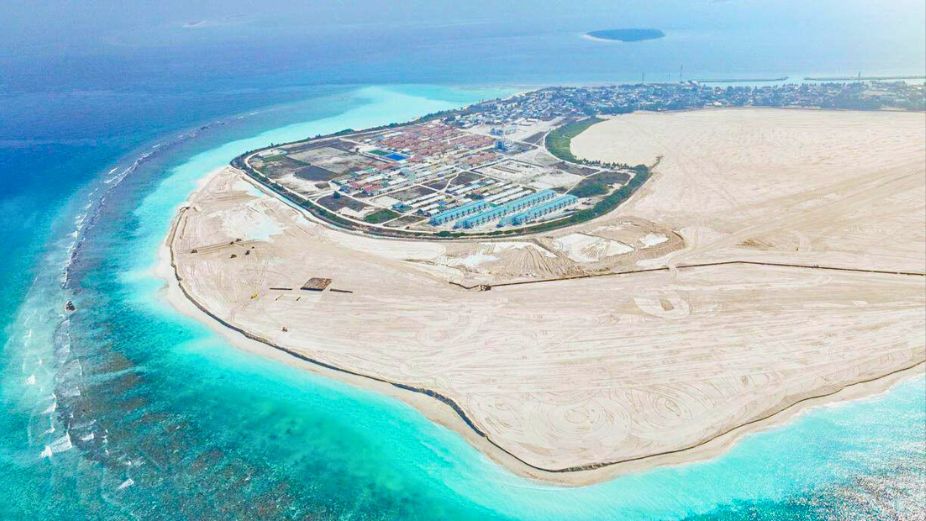

Land reclamation for the planned airport in Dhidhdhoo has been successfully completed, establishing an important foundation for expanding aviation infrastructure in the northern Maldives and strengthening regional connectivity across the country’s northernmost atolls. The reclamation operation created approximately 112 hectares of new land within a period of fifty days, providing space not only for the future airport facility but also for housing developments and commercial zones designed to support long-term economic growth alongside the aviation project.
The reclamation works were carried out using the Leiv Eiriksson, a trailing suction hopper dredger recognized internationally for its high-capacity dredging capabilities. The completion of the project within an accelerated timeframe reflects the strategic importance placed on improving accessibility to northern communities, where geographic distance and reliance on sea transport have historically limited mobility, economic diversification, and timely access to public services. Enhanced aviation infrastructure is expected to reduce travel uncertainty and create more efficient links between remote islands and national as well as international gateways.
Dhidhdhoo serves as a key administrative and service hub in Haa Alifu Atoll, with an official population of approximately 5,000 residents and an estimated actual population nearing 7,000 due to inward migration driven by healthcare, education, and employment opportunities. Across the atoll, which is home to roughly 16,000 residents distributed among fourteen inhabited islands, transportation options remain constrained, with communities largely dependent on maritime travel and a single operational airport serving the region. The introduction of a second aviation facility is anticipated to significantly improve resilience and capacity within the regional transport network.
The proposed airport forms part of broader development planning aimed at creating a more integrated economic corridor across the northern Maldives. Improved air connectivity is expected to influence trade and logistics efficiency, facilitate easier movement for residents, and enhance access to essential services. The project also carries strong potential to support tourism expansion and encourage entrepreneurship across nearby islands such as Vashafaru, Filladhoo, Kelaa, Muraidhoo, Baarah, and Utheemu, where improved accessibility can stimulate investment opportunities and strengthen local economies.
Beyond aviation benefits, the reclamation initiative addresses growing demographic pressures faced by Dhidhdhoo by expanding the island’s usable land area. The additional space provides opportunities for structured urban planning, residential development, and commercial activity aligned with future growth needs. As the airport project progresses, its integration with housing, business infrastructure, and regional transport systems is expected to play an important role in ensuring sustainable economic outcomes, positioning northern Maldives as an increasingly connected and attractive destination for residents, investors, and international visitors alike.
 advertisment



 advertisment