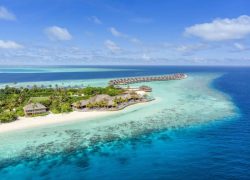
Nestled in the heart of the Indian Ocean, the Maldives might appear as a remote paradise of pristine beaches and turquoise lagoons. However, its culture tells a story of a centuries-old, transformative relationship with the Arabic world, a connection that has shaped the very identity of the Maldivian people. This bond, forged by trade, faith, and language, is most evident in the nation’s official religion, its script, and its very name.
The Gateway: Trade and the Advent of Islam
The relationship began not with conquest, but with commerce. Situated along the major maritime trade routes connecting the Middle East to South and Southeast Asia, the Maldives was a strategic stopover for Arab dhows. These traders, sailing from ports in Yemen, Oman, and the wider Gulf, were not only merchants of spices, textiles, and pearls but also carriers of culture and ideas.
The most pivotal moment in Maldivian history was the arrival of Islam in 1153 AD. According to Maldivian legend, an Arab scholar and saint named Abu al-Barakat Yusuf al-Barbari is credited with converting the last Buddhist king, King Dhovemi, to Islam. The king, persuaded by the scholar’s teachings and his apparent ability to pacify a malevolent sea spirit, embraced the new faith and took the title Sultan Muhammad al-Adil. From that point forward, Islam became the state religion, fundamentally reorienting Maldivian society towards the spiritual and cultural center of the Arabic world—Mecca.
The Pillars of Cultural Influence
1. Religion: The Bedrock of Identity
Islam is the cornerstone of modern Maldivian culture and the official religion of the state. Its influence is omnipresent:
-
Law and Society: The legal system is a blend of traditional law and Sharia principles.
-
Daily Life: The call to prayer echoes from whitewashed mosques across the islands, daily life is structured around the five prayers, and the calendar is marked by Islamic holidays like Ramadan and Eid.
-
Architecture: The distinctive Maldivian mosques, with their intricate coral stone carvings and minimalist design, while unique, serve the same purpose as their grand counterparts in the Arab world, facing towards Mecca.
2. Language: The Script of Faith and History
While the Maldivian native language, Dhivehi, is an Indo-Aryan language with roots in Sri Lanka, its script, Thaana, reveals a profound Arabic influence. Developed in the 16th century, the Thaana script is unique, but its characters are derived from Arabic numerals and Persian letters. Furthermore, a significant number of Arabic words have been incorporated into Dhivehi, especially terms related to religion, law, education, and time.
3. The Name “Maldives”
The very name of the country is believed by many scholars to have Arabic origins. Early Arab geographers referred to the islands as “Mahal Dibiyat,” which is thought to be derived from the Sanskrit Maladvipa (“garland of islands”), but filtered through Arabic pronunciation. This name later evolved into “Maldives” in English.
4. Education and Scholarship
For centuries, the center of learning in the Maldives was the Madhrasa (Islamic school). Children were taught to read and write Arabic to recite the Quran, and higher Islamic studies were highly valued. This created a class of scholars who maintained intellectual and religious links with centers of learning in the Arab world, such as Al-Azhar University in Cairo.
A Lasting and Evolving Relationship
This historical connection remains vibrant today. The Maldives is a member of the Organisation of Islamic Cooperation (OIC). Many Maldivians perform the Hajj pilgrimage to Mecca, a deeply spiritual journey that reinforces the physical and spiritual link to the Arabian Peninsula. Furthermore, economic and developmental aid from Arab nations has played a significant role in the modern history of the Maldives.
In conclusion, the relationship between the Maldives and the Arabic world is a powerful example of cultural osmosis. It was not a relationship of imposition, but one of adoption and adaptation. The Maldivians embraced Islam and integrated Arabic elements into their language and administration, weaving them seamlessly with their own unique South Asian traditions and island identity. The result is a distinctive national culture where the call to prayer rises over palm-fringed atolls—a lasting testament to a bond forged by the winds of trade and the power of faith.
 advertisment



 advertisment