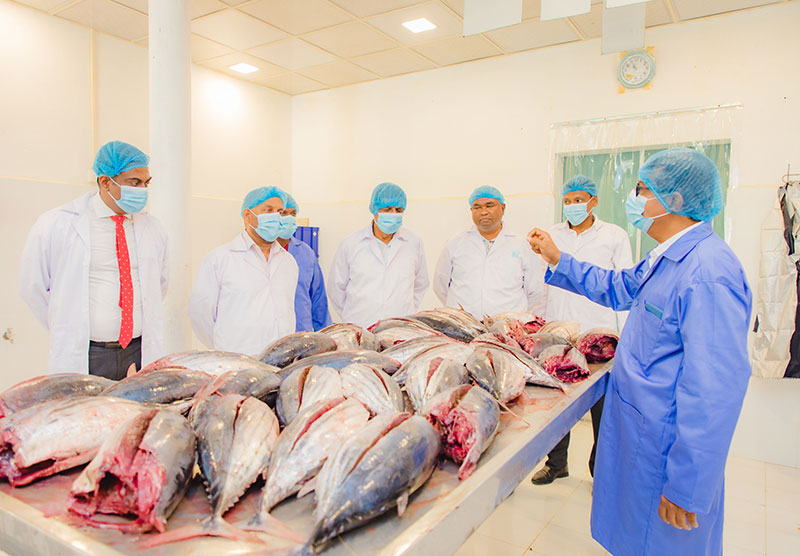

Maldives’ seafood exporters are finding new momentum in the American market following the recent revision of US trade tariffs, which have significantly increased duties on most exporting countries, while maintaining a minimal 10 percent rate on Maldivian goods. Industry leaders and trade experts say this development could position the Maldives as a more competitive and attractive supplier of premium-grade seafood to the United States.
This comes after the United States, under a revised global trade policy, introduced a universal tariff structure affecting major fish-exporting nations. Competitors such as Vietnam, Sri Lanka, Indonesia, and the Philippines are now facing steep tariff hikes ranging from 17 to 46 percent. Vietnam, for instance, has seen a sharp increase from zero to 46 percent, raising their cost of entry into the US market. In contrast, Maldivian fish exports continue with only a 10 percent tariff, providing a considerable advantage in maintaining price competitiveness and supply consistency.
Shaafin Ahmed, Chief Executive Officer of Big Fish Maldives—the nation’s largest tuna exporter to the US, highlighted that this shift presents a valuable window of opportunity. “On average, we export two to three containers of frozen tuna to the US each month. With the current tariff situation, Maldivian fish remains well-positioned in terms of pricing and quality,” he said. Shaafin estimates the company earns approximately USD 2 million per month from exports to the United States alone, underscoring the substantial economic impact of continued access to this lucrative market.
Meanwhile, Hussain Afeef, Commercial Director of Ensis, one of the Maldives’ leading raw fish exporters, noted that while the low tariff benefits are clear, there is room for growth in terms of enhancing the size and quality of exports. “If we can bring back the export standards we maintained in 2017, we would regain significant market share in the US,” he stated. Although Ensis has faced challenges in recent years due to fluctuations in fish quality and availability, Afeef remains optimistic about long-term potential given the favorable trade conditions.
Customs data from last year shows that the Maldives exported around USD 4 million worth of seafood to the United States, including popular varieties such as blackfin tuna, yellowfin tuna, and sea cucumbers. Despite a recent dip in overall fish export volumes, reportedly down by 50 percent over the past two years, the stable tariff environment offers renewed encouragement for investment in fisheries and processing capacity.
Trade experts and exporters agree that the key to fully realizing this opportunity lies in boosting production volume and maintaining strict quality standards. The current administration’s ongoing support for fisheries infrastructure, international trade relations, and sustainable resource management is seen as critical to enabling Maldivian exporters to scale up and meet growing demand in high-value markets like the United States.
With its world-renowned fisheries, sustainable practices, and now a unique competitive edge in tariffs, the Maldives is once again asserting its place on the global seafood map, offering not just pristine islands and luxury holidays, but also premium products that are making waves across international markets.
 advertisment




 advertisment