
President Dr. Mohamed Muizzu has reaffirmed the Government’s commitment to expanding the Maldivian economy through carefully developed economic policies, stronger implementation of existing legislation, major infrastructure development and increased investment in the country’s technical workforce.
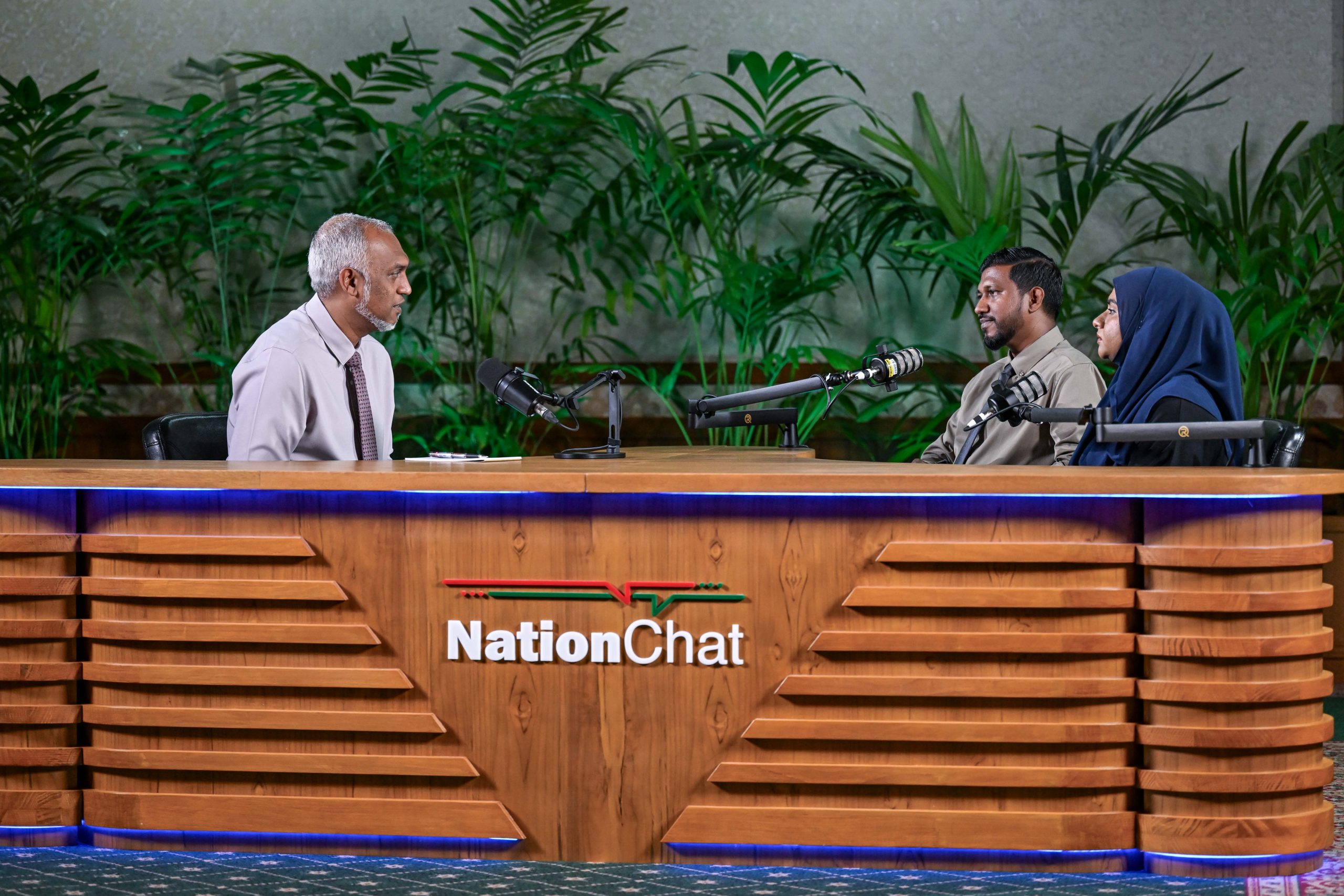
Speaking on the “NationChat” podcast last night, President Muizzu said the Government is pursuing a number of measures designed to strengthen the economy, including policies related to foreign currency management and the enforcement of legal provisions that had previously remained unimplemented. He emphasised that decisions taken by the administration are based on the economic and developmental realities facing the Maldives and are intended to support sustainable national growth.
The President said Government decisions and amendments to legislation are guided by clear principles and developed following extensive consultations, technical assessments and studies carried out over a considerable period. According to the President, teams comprising academic and technical experts contribute to the formulation of these policies, allowing decisions to be based on detailed analysis and the long-term interests of the country.
President Muizzu assured the public and the business community that the central objective of the Government’s economic policies is to expand economic activity and strengthen the foundations for future growth. He said the administration would not introduce measures that could negatively affect economic expansion, noting that economic policy decisions are being structured to improve the country’s overall financial position while supporting businesses, investment and national development.
Foreign currency management remains an important area of focus for the Government, particularly as the Maldives continues to strengthen its financial system and address structural pressures associated with demand for foreign currency. President Muizzu expressed confidence that the measures being implemented to address foreign currency challenges would ultimately deliver positive results for the economy.
While acknowledging that some of these policies have generated political discussion, the President said the Government remains confident in their overall effectiveness. He indicated that the benefits of the measures would become increasingly evident as implementation progresses, contributing to improved economic conditions and greater stability.
The Maldives has an economy that is closely connected to international markets, with significant requirements for foreign currency to support imports, infrastructure development, investment and commercial activity. The Government’s broader economic strategy therefore places importance on improving financial management while maintaining conditions that allow businesses and productive sectors to grow. The President’s remarks underline the administration’s position that economic reforms must be designed around the country’s practical requirements rather than short-term considerations.
President Muizzu also provided an update on the Thilamalé Bridge, one of the country’s most significant ongoing infrastructure projects. The bridge is designed to strengthen connectivity within the Greater Malé region by linking Malé, Villingili, Gulhifalhu and Thilafushi, creating an important transport corridor between key residential, commercial and industrial areas.
Responding to comments concerning construction quality, the President said the quality of the project is being ensured with the involvement of Arup, an internationally recognised engineering and consultancy company. He noted that Arup also provided oversight in connection with the Sinamalé Bridge, which currently connects Malé with Hulhulé and Hulhumalé.
With Malé and Villingili now connected through the ongoing bridge development, President Muizzu said work would continue towards completing the remaining sections of the project. He stated that the entire bridge extending to Thilafushi is expected to be completed and opened to the public in approximately one year.
Completion of the Thilamalé Bridge is expected to significantly improve physical connectivity across the western side of the Greater Malé region. Thilafushi is a major industrial centre, while neighbouring Gulhifalhu is being developed to support important economic and infrastructure activities. Improved road connectivity between these areas and the capital is expected to provide greater convenience for businesses, workers and residents while strengthening the movement of people, goods and services.
The project is also expected to support the Government’s broader approach to decentralising economic activity within the densely populated capital region. By improving access to industrial and development zones outside central Malé, enhanced transport infrastructure has the potential to facilitate new investment, strengthen logistics and improve the efficiency of commercial operations.
Alongside economic policy and infrastructure development, President Muizzu highlighted the importance of developing a stronger Maldivian workforce in science, engineering and other technical disciplines. He said national development requires a wider range of specialised professionals capable of contributing directly to major infrastructure, technology and industrial projects.
The President observed that while many Maldivian students pursue qualifications in areas such as business and law, the country also needs a greater number of civil, electronic and mechanical engineers. Strengthening participation in these fields would help build domestic professional capacity and increase the involvement of Maldivians in designing, managing and maintaining the country’s expanding infrastructure.
Developing local technical expertise is particularly important as the Maldives continues to undertake increasingly sophisticated construction, transport, energy and technology projects. A larger pool of qualified Maldivian engineers and technical specialists would allow the country to retain greater institutional knowledge, reduce reliance on external expertise in specialised areas and create additional high-skilled career opportunities for young Maldivians.
President Muizzu said the Government’s combined focus on economic reform, infrastructure development and human capital reflects a long-term strategy aimed at creating a stronger foundation for the Maldives. The administration is seeking to align financial policy with major development projects while ensuring that Maldivians are equipped with the knowledge and technical skills required to participate fully in the country’s future economic transformation.
The President’s remarks reflect the Government’s wider emphasis on building a more resilient and diversified economy supported by improved infrastructure, responsible financial management and a highly skilled national workforce. As major projects such as the Thilamalé Bridge advance and economic reforms continue to be implemented, the Government remains focused on strengthening the Maldives’ capacity for sustainable growth and creating broader opportunities for future generations.
 advertisment


 advertisment