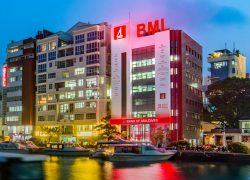

The Bank of Maldives (BML) has underscored the importance of maintaining public confidence in the country’s financial system, warning that misinformation or unfounded speculation surrounding financial institutions could have serious consequences for the wider Maldivian economy and its international banking relationships.
Speaking during a panel discussion titled “Two Sides of the Economy,” organised by the Ministry of Economic Development, Transport and Trade, BML’s Head of Brand and Marketing Strategy, Mohamed Saeed, said confidence in the banking sector remains critical to safeguarding the Maldives’ access to international financial networks and ensuring the uninterrupted availability of banking services for individuals and businesses.
Saeed explained that inaccurate information concerning financial institutions, particularly the country’s largest commercial bank, can generate unnecessary public concern while also affecting relationships with correspondent and international banking partners. Such relationships are especially important for an economy such as the Maldives, which is highly connected to international trade, tourism, overseas education, healthcare services and cross-border financial transactions.
He cautioned that the loss of even a single international banking partnership could create significant operational difficulties, particularly for Maldivians who need to transfer money overseas, students studying abroad and residents who rely on their Maldivian bank cards for international transactions. Maintaining the credibility and strength of the domestic financial system therefore remains closely connected to the country’s broader economic stability.
Providing an overview of BML’s foreign currency operations, Saeed highlighted the considerable increase in demand for US dollars over recent years. In 2023, BML sold an average of approximately USD 40 million per month to individuals and businesses. By 2026, the monthly average has more than doubled to over USD 81 million, reflecting the substantial expansion in demand for foreign currency across the economy.
During the first half of 2026 alone, BML facilitated approximately USD 570 million in foreign currency sales, equivalent to an average of around USD 2.7 million per day. The figures demonstrate the scale of foreign currency being channelled through the banking system to support households, businesses, travellers and essential economic activities.
Saeed said the bank continues to give particular importance to critical requirements such as education and healthcare. Foreign currency allocations for students have remained stable, helping Maldivians studying overseas meet their education-related financial commitments without disruption.
Support for medical travel has expanded considerably. According to Saeed, BML previously provided approximately USD 1 million per month for medical requirements, while the amount has increased to around USD 3 million per month in 2026. The threefold increase reflects the bank’s efforts to respond to growing demand while continuing to prioritise essential services for Maldivian families.
He also highlighted significant changes in customer demand for access to physical US dollars. US dollar ATM withdrawals have increased substantially, illustrating growing foreign currency requirements among customers and the wider economy. Saeed said monthly withdrawals reached USD 188 million last month, compared with earlier levels when average daily withdrawals were approximately USD 1.6 million.
Customer behaviour in international card usage has also changed considerably over recent years. Before the COVID-19 pandemic, approximately 90,000 customers used Maldivian rufiyaa-denominated cards for overseas travel and online transactions. The number has since expanded sharply, with between 280,000 and 300,000 customers now regularly making international transactions using MVR cards.
Saeed said BML is currently serving at least 280,000 customers conducting foreign transactions through MVR cards, highlighting the increased operational and foreign currency requirements created by the rapid growth in international card usage.
“At present, the lowest number of customers using foreign transactions stands at 280,000 using MVR cards. We are currently catering to these numbers. However, there are challenges. God willing, through our ongoing efforts, we will overcome these difficulties and expand the limits,” he said.
The significant growth in transaction volumes reflects changes in the Maldivian economy and consumer behaviour, including increased international travel, overseas education, digital commerce and online purchases. BML’s continued provision of foreign currency services therefore represents an important component of the country’s financial infrastructure at a time when demand has expanded well beyond pre-pandemic levels.
Saeed also highlighted the close relationship between the financial position of BML and the wider performance of the Maldivian economy. He said the correlation coefficient between BML’s financial strength and the national economy stands at 0.96, illustrating the strong connection between the country’s largest banking institution and overall economic activity.
The bank also continues to play a major role in financing businesses, investment and national development. During the first seven months of 2026, BML issued MVR 8.9 billion, equivalent to approximately USD 577.2 million, in new loans across the economy.
Of this financing, approximately USD 270 million was provided directly in US dollars, demonstrating the scale of foreign currency lending being extended to businesses and other borrowers. Such financing remains important for sectors that depend heavily on imported goods, equipment, infrastructure investment and internationally sourced services.
The figures presented during the discussion also highlight the increasing scale and complexity of managing foreign currency demand in a highly import-dependent and internationally connected island economy. With hundreds of thousands of customers now using international banking services and demand for dollars more than doubling compared with 2023 levels, maintaining strong banking institutions and reliable international financial relationships remains central to economic stability.
The Government has continued to focus on strengthening economic management, expanding productive activity and improving financial sector resilience while addressing the pressures associated with foreign currency demand. Cooperation between public institutions, financial sector stakeholders and businesses remains important as the Maldives works to strengthen economic fundamentals and ensure that essential foreign currency requirements continue to be served.
BML’s latest figures indicate that despite rising demand and operational pressures, the banking sector continues to channel substantial amounts of foreign currency into the economy while supporting healthcare, education, international payments and business financing. The bank’s message also reinforces the importance of public confidence and responsible communication in protecting the stability of a financial system that remains closely interconnected with the Maldives’ wider economic development.
 advertisment




 advertisment