
The Maldives and India are preparing to expand bilateral economic cooperation, with tourism investment, financial technology, renewable energy, fuel supply and cross-border trade expected to contribute significantly to the next phase of relations between the two neighbouring countries.
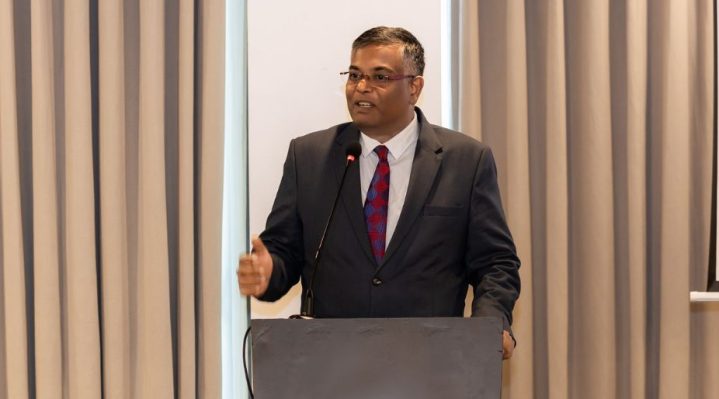
Indian High Commissioner to the Maldives G. Balasubramanian said Indian companies have established a growing presence in the Maldivian tourism and agriculture sectors, while additional investments are expected to enter the market. Speaking on the Trade Desk podcast produced by the Ministry of Economic Development, Transport and Trade, the High Commissioner highlighted the increasing interest of Indian businesses in opportunities available across the Maldivian economy.
An Indian company is currently undertaking agricultural projects in Baa Atoll, reflecting efforts to strengthen commercial agriculture and improve the availability of locally produced goods. Another Indian company is expected to introduce a new investment in the Maldives later this year, further expanding private-sector engagement between the two countries.
Indian participation in the Maldivian tourism industry is also continuing to grow, with approximately six or seven companies currently developing resorts in different parts of the country. These projects demonstrate sustained investor confidence in the Maldives as one of the world’s leading island tourism destinations and are expected to contribute to the continued expansion of the country’s hospitality sector.
The development of new resorts can generate wider economic benefits through construction activity, employment creation, staff training, transport services, food supply, logistics, maintenance and other supporting industries. Resort investments also create commercial opportunities for local contractors, small and medium-sized enterprises, farmers, fishermen, tour operators and service providers seeking to participate in the tourism value chain.
The Maldives’ internationally recognised resort model, which offers private-island hospitality experiences surrounded by the Indian Ocean, continues to attract investors seeking opportunities in high-quality leisure tourism. New developments can support the introduction of additional accommodation capacity, modern guest facilities and environmentally responsible infrastructure while enabling more atolls and island communities to benefit from tourism-related economic activity.
Indian investment in resort development could further strengthen commercial links between the two countries by encouraging the movement of tourists, professionals, technical expertise, construction materials and hospitality services. It could also support joint ventures between Maldivian and Indian businesses and create additional avenues for cooperation in resort management, digital services, sustainable construction and workforce development.
While tourism remains an important area of cooperation, the High Commissioner indicated that future engagement is likely to extend more prominently into financial technology, energy supply and renewable energy. Cooperation in these sectors could help diversify the economic relationship and create practical benefits for businesses and consumers in both countries.
India is working with the Maldivian Government and Payment Maldives on the introduction of financial technology systems, including India’s Unified Payments Interface. The proposed development could support faster, more accessible and efficient cross-border payment services, particularly for tourists, businesses and individuals conducting transactions between the Maldives and India.
The introduction of compatible digital payment systems could simplify payments for accommodation, transportation, retail services and other tourism-related expenses. It could also reduce transaction barriers for Maldivian businesses dealing with Indian customers and suppliers, while supporting the Maldives’ broader efforts to strengthen its digital economy and modernise financial services.
The two governments are also working to improve the legal and commercial framework governing bilateral investment. Negotiations are under way to finalise a bilateral investment treaty intended to provide stronger protection and greater certainty for Maldivian investments in India and Indian investments in the Maldives.
A strengthened investment protection framework could encourage companies to undertake long-term projects by establishing clearer legal safeguards, dispute-resolution arrangements and standards for the treatment of investors. Such measures are particularly relevant for major investments in tourism, renewable energy, infrastructure, agriculture and technology, where projects may require substantial financing and long implementation periods.
Discussions have also commenced on a bilateral Free Trade Agreement, with the Terms of Reference already signed. The proposed agreement is being developed at a SAFTA Plus level and is expected to address barriers affecting the movement of goods and services between the two markets.
According to High Commissioner Balasubramanian, the Maldives currently provides tourism services to India valued at approximately USD 300 million to USD 400 million annually. India remains an important tourism source market for the Maldives, while improved trade arrangements could create additional opportunities for Maldivian businesses seeking access to India’s large consumer and commercial market.
Maldivian tuna already enters India without import duties, providing an important advantage for one of the Maldives’ principal export industries. A broader trade agreement could extend preferential access to additional Maldivian goods and services, improve export opportunities and create more favourable conditions for Indian companies investing in the Maldives.
Enhanced market access could benefit Maldivian fisheries products, tourism services and other emerging industries while supporting greater participation by small and medium-sized businesses in bilateral trade. Improved customs procedures, regulatory cooperation and clearer commercial rules could also help businesses reduce costs and enter new markets more efficiently.
Energy cooperation is expected to become another significant component of the relationship. India recently exempted petroleum exports to the Maldives from the Special Additional Excise Duty and the Road and Infrastructure Cess. These exemptions could reduce the cost of future fuel imports from India, particularly if Maldivian state-owned enterprises increase their procurement of refined petrol and diesel from the country.
More competitive fuel procurement could support transport, electricity generation, tourism operations, fisheries and other sectors that rely heavily on imported energy. Cooperation in renewable energy could also assist the Maldives in reducing its dependence on imported fossil fuels, improving energy security and expanding the use of cleaner technologies across inhabited islands, resorts and public infrastructure.
The continuing expansion of tourism investment, negotiations on trade and investment agreements, cooperation on digital payments and emerging partnerships in energy demonstrate a broader and increasingly diversified economic relationship between the Maldives and India. These developments are expected to strengthen business confidence, support sustainable economic growth and create new opportunities for investors, companies and communities in both countries.
 advertisment




 advertisment