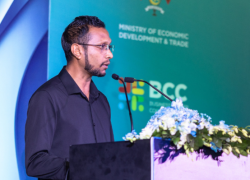
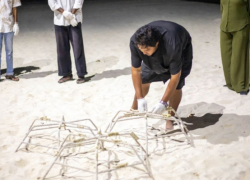
His Excellency Vice President Uz Hussain Mohamed Latheef has called for stronger international cooperation and increased climate finance to help vulnerable countries respond to the growing challenges of climate mobility, underscoring the urgency of collective action in the face of accelerating climate change. Delivering the opening statement at the High-Level Segment on the Climate Mobility Principles during the Berlin Climate Mobility Forum 2026, the Vice President stated that climate change is already shaping the lives of Maldivians, influencing the future of the country’s islands and its broader development trajectory. He emphasised that climate mobility is no longer a matter for the distant future, but an immediate and pressing reality that requires practical, sustainable, and people-centred solutions.
In his remarks, the Vice President highlighted the Maldives’ continued commitment to building safer and more climate-resilient islands through sustained investments in coastal protection, resilient infrastructure, and adaptation efforts across multiple sectors. He noted that the Maldives has been actively pursuing development strategies that strengthen community resilience while safeguarding livelihoods and national progress. Referring to Hulhumalé as a leading example of climate-resilient urban development, he explained that the project demonstrates how forward-looking planning can help address environmental vulnerability while also creating improved living conditions and long-term opportunities for communities. He further noted that Ras Malé builds on this same vision, representing an important part of the Maldives’ efforts to develop durable solutions that support human security, population sustainability, and economic opportunity in a changing climate.
The Vice President stressed that climate mobility responses must be rooted in resilience, prevention, and the expansion of opportunities for people to remain safely in their home communities wherever possible. He noted that the priority should be to ensure that communities are supported through measures that reduce vulnerability and strengthen their capacity to adapt locally. At the same time, he said that where movement of people becomes necessary, it must be approached in a planned, voluntary, and dignified manner, in full recognition of the rights and wellbeing of affected populations. His remarks reflected the Maldives’ longstanding advocacy for solutions that place people at the centre of climate action and uphold the dignity of communities most exposed to environmental risks.
Addressing the international community, the Vice President underscored the importance of adequate and accessible climate finance, noting that vulnerable countries cannot meet these growing challenges on their own. He called on development partners to expand concessional and grant-based financing, alongside greater technology transfer and capacity-building support specifically tailored to the needs of small island developing states. He emphasised that countries such as the Maldives require not only recognition of their vulnerability, but also meaningful support mechanisms that enable them to implement adaptation strategies, strengthen resilience, and plan for the future with confidence.
Concluding his statement, the Vice President welcomed the Climate Mobility Principles and reaffirmed the Maldives’ support for people-centred and rights-based approaches to climate mobility. He stressed that while principles provide an important foundation, they must be matched by concrete action, practical support, and sustained international commitment to ensure that affected communities are able to build resilient and secure futures. His address at the Berlin Climate Mobility Forum 2026 reflected the Maldives’ continued role as a strong and constructive voice in global climate discussions, advocating for solutions that are inclusive, humane, and responsive to the realities faced by vulnerable island nations.
 advertisment



 advertisment