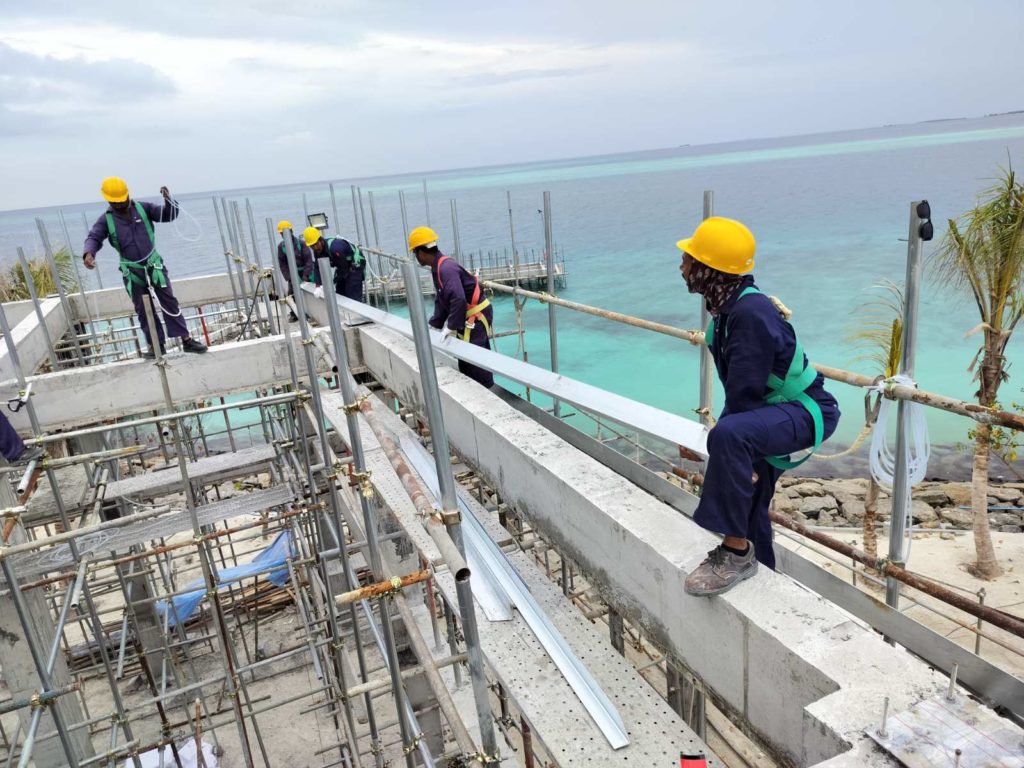

Construction businesses in the Maldives experienced a softer start to 2026, as weaker activity, slower order growth, tighter credit conditions and elevated input costs shaped the sector’s performance during the first quarter. According to the latest quarterly business findings, the industry entered a more challenging operating environment compared with the previous quarter, reflecting the combined effect of financing constraints, external supply pressures and continued increases in operating expenses. Even so, the sector continues to demonstrate a degree of resilience, with businesses still maintaining investment activity and adjusting pricing strategies to manage cost burdens.
The index measuring overall construction activity fell by 50 points from the previous quarter to minus one, indicating a noticeable loss of momentum across the industry. At the same time, the index for new orders declined by 43 points to zero, showing that the proportion of firms reporting higher contract volumes was equal to those reporting a decline. Among all sectors covered in the survey, construction was the only one to record an overall weakening in activity during the quarter, underlining the specific pressures currently facing contractors and developers.
Business sentiment for the second quarter also became more cautious. Companies reported lower confidence in near-term prospects, with the expected construction activity index slipping to minus nine and anticipated new orders falling to minus 12. This suggests that many firms are preparing for a continued period of subdued demand, even as they work to sustain ongoing projects and respond to market conditions. For an industry that plays a central role in supporting infrastructure, housing and tourism-related development, these expectations point to a period of adjustment rather than expansion.
Employment trends also reflected this moderation. Although the employee index remained in positive territory at 14 during the first quarter, it fell by 19 points from the previous quarter, indicating a slowdown in labour demand. More notably, expectations for employment in the following quarter turned negative at minus five, suggesting that some firms may become more cautious in workforce planning if order books remain under pressure and financing conditions do not improve. This development is particularly important for a sector that supports a broad range of skilled and semi-skilled jobs across the country.
Financial conditions became more difficult for businesses over the quarter. The index measuring companies’ financial position dropped from 15 to minus 13, while the broader business situation index declined from 20 to minus 18. These figures reflect the extent to which profitability and operating conditions are being tested by a combination of weaker activity and rising costs. Restricted access to credit remains one of the most significant issues affecting the sector. The credit access index weakened further to minus 48 during the first quarter, with 48 per cent of construction firms reporting tighter financing conditions. Looking ahead, 51 per cent of respondents expect access to credit to tighten further in the second quarter, pushing the expected credit access index to minus 51.
At the same time, cost pressures remained elevated. The input price index held steady at 54, indicating that construction businesses continue to face substantial increases in the cost of materials and services required to deliver projects. The index for prices charged by construction businesses rose sharply by 33 points to 50, showing that more firms have raised their selling prices in an effort to absorb or offset higher expenses. Businesses expect input prices excluding wages to rise by 29 per cent in 2026, compared with 13 per cent in 2025. Selling prices are projected to increase by 14 per cent this year, up from five per cent last year, while wages are expected to rise by 13 per cent.
Many firms have already begun transferring part of these additional costs to customers. Half of the businesses surveyed said they were passing on some of their higher costs, while 22 per cent reported transferring most of the increase and six per cent said all additional costs were being passed on. This pattern indicates that pricing adjustments are becoming a necessary part of business continuity in a market where margins are under growing pressure. Energy and material prices were identified as the biggest contributors to cost increases, accounting for 31 per cent and 30 per cent of responses respectively, while freight and shipping costs made up a further 14 per cent.
Supply chain disruption also emerged as a major concern for the sector. A significant 61 per cent of construction businesses said they had been severely affected by disruption linked to the closure of the Strait of Hormuz, while another 33 per cent reported a moderate or mild impact. For an island nation that depends heavily on imported construction materials, machinery and fuel, such external disruptions can have a direct effect on project scheduling, procurement efficiency and overall budget performance. These developments highlight how global trade routes and regional logistics challenges continue to influence the pace and cost of domestic construction activity in the Maldives.
Despite the weaker operating environment, capital expenditure remained positive during the first quarter, offering a constructive sign that businesses are still willing to invest, although more selectively. However, expectations for future investment moderated sharply, with the capital expenditure outlook declining by 30 points to 15. This suggests that while firms are not halting investment altogether, they are likely to become more measured in committing resources until order flows improve and financing conditions stabilise.
Overall, the first quarter results present a picture of a construction sector navigating a demanding period shaped by slower contract activity, restricted financing and persistent cost escalation. At the same time, the sector’s continued investment activity and efforts to manage pricing demonstrate its determination to remain operational and responsive under pressure. For global readers observing the Maldivian economy, the findings illustrate both the vulnerabilities and the adaptability of a sector that remains essential to the country’s broader development trajectory. As the year progresses, the interaction between credit availability, supply chain stability and cost management will be central to determining how quickly construction businesses regain momentum and how effectively they can deliver projects in a more complex commercial environment.
 advertisment




 advertisment