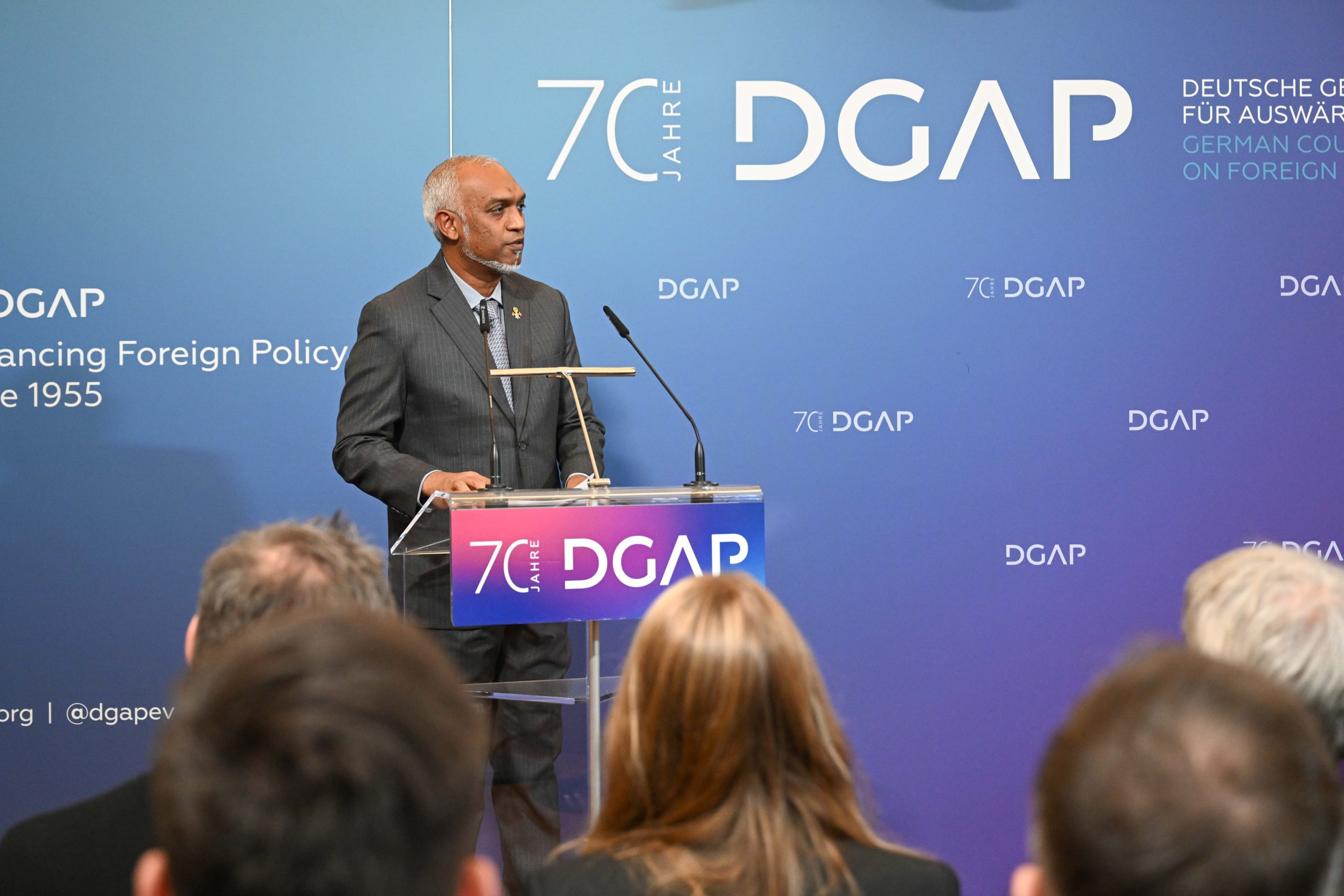

His Excellency President Dr Mohamed Muizzu visited the Deutsche Gesellschaft für Auswärtige Politik (DGAP), the German Council on Foreign Relations, during his official visit to Germany at the invitation of His Excellency President Frank-Walter Steinmeier. The visit formed part of high-level engagements aimed at strengthening dialogue and cooperation between the Maldives and Germany on global strategic priorities.
At DGAP, President Dr Muizzu was received by Mr Rolf Nikel, Vice-President of DGAP; Mr Thomas Kleine-Brockhoff, Director of DGAP; and Dr Kira Vinke, Deputy Research Director and Head of the Centre for Climate and Foreign Policy. The engagement provided a platform for in-depth discussions on the evolving role of the ocean in international relations, climate diplomacy, and global governance.
Delivering a keynote address, President Dr Muizzu underscored the critical importance of the ocean in shaping foreign policy frameworks. He emphasised that while the ocean plays a decisive role in climate regulation, biodiversity preservation, and global food security, it remains insufficiently reflected in strategic and diplomatic discourse. Drawing on the Maldives’ unique national experience, he explained that the country’s history, economy, culture, and national security are intrinsically linked to the ocean, making sustainable ocean governance not only a policy priority but a national imperative.
The President highlighted the profound impact of climate change on the Maldives, noting that rising sea levels, coastal erosion, and environmental pressures directly affect livelihoods and economic resilience. He stressed that for small island developing states, climate action and ocean sustainability are inseparable from long-term development planning and stability.
Addressing the broader geopolitical context, President Dr Muizzu observed that the Maldives is located at the crossroads of major international trade routes and within a region experiencing increased strategic competition. He described the Indian Ocean as one of the most consequential regions of the 21st century, with implications extending well beyond the region itself. In this regard, he emphasised the importance of ensuring that the ocean remains a domain of cooperation rather than contention.
The President also drew attention to the strategic significance of undersea digital infrastructure, noting that the majority of global data traffic is transmitted through submarine cables. He called for strengthened international cooperation, shared norms, and trust-based partnerships to safeguard this critical infrastructure, recognising its central role in the functioning of the global economy and communication systems.
In his address, President Dr Muizzu pointed to the growing role of small states as contributors to global norm-setting. He highlighted how small island nations have consistently advocated ambitious climate action, stronger marine protection measures, and inclusive multilateral engagement. He affirmed that an ocean-centred foreign policy is existential for the Maldives and indispensable for the international community, adding that the governance of the ocean will shape not only the future of small island nations but also the wider international order.
The President reaffirmed the Maldives’ readiness to collaborate with Germany and other like-minded partners to promote sustainability, shared responsibility, and cooperative approaches to ocean governance. He expressed confidence that enhanced cooperation can deliver practical outcomes in areas such as marine protection, climate resilience, and environmental sustainability.
During the subsequent question-and-answer session, President Dr Muizzu elaborated on the Maldives’ approach to ocean security and sustainability. He outlined a strategy grounded in strong and constructive relations with neighbouring countries and international partners, respect for territorial integrity, and a firm commitment to environmental protection. He also highlighted ongoing efforts to strengthen national capacity to safeguard the Maldives’ Exclusive Economic Zone, underscoring the country’s proactive stance in protecting its marine resources.
Reflecting on six decades of diplomatic relations between the Maldives and Germany, the President noted the substantial progress achieved and the considerable scope for further collaboration. He identified opportunities to expand cooperation, including in shore protection initiatives and climate adaptation efforts, areas that are critical to the Maldives’ long-term resilience and sustainable development.
The engagement at DGAP demonstrated the Maldives’ active participation in shaping global conversations on ocean governance and climate policy. President Dr Mohamed Muizzu’s address reinforced the country’s position as a committed advocate for sustainable ocean management and constructive international partnership, contributing to a forward-looking agenda that resonates with global audiences and shared aspirations for a stable, sustainable future.
 advertisment



 advertisment