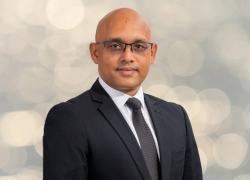
At the Second World Summit for Social Development (WSSD2) held in Doha, Qatar, His Excellency Vice President Uz. Hussain Mohamed Latheef delivered a powerful address that reaffirmed the Maldives’ unwavering commitment to inclusive social progress. Representing the Maldives on the global stage, the Vice President emphasized the country’s dedication to building an equitable and resilient future, especially for Small Island Developing States (SIDS) navigating compounded vulnerabilities.
Held nearly three decades after the inaugural World Summit for Social Development in Copenhagen in 1995, WSSD2 gathered heads of state and government, international organizations, civil society leaders, and private sector stakeholders to evaluate global progress and reignite commitment toward social equity and sustainable development.

In his plenary statement, Vice President Latheef reflected on the aspirations set in 1995 to position social development at the core of peace, prosperity, and dignity. However, he noted that despite these ambitions, global progress has been uneven. He cited that gender equality remains stalled, social disparities continue to deepen, and the ongoing climate crisis has worsened existing socio-economic fragilities—particularly for countries like the Maldives, where environmental vulnerability intersects with developmental challenges.
Addressing the unique realities of SIDS, Vice President Latheef stated that Maldivians are the country’s greatest resource and that advancing human capital is central to the national development strategy. The Maldives, he said, has made major strides in strengthening healthcare, education, digital access, and climate resilience, guided by the Sustainable Development Goals (SDGs) and national priorities that place people at the center of all policies.
A major highlight of his statement was the Maldives’ innovative proposal to convert national debt into resilience-building instruments. This forward-thinking approach would enable countries to unlock fiscal space to enhance social protection systems, invest in climate-resilient infrastructure, and expand digital inclusion to reduce inequality and promote inclusive growth.
The Vice President proudly noted several of the Maldives’ national achievements in recent years. These include the establishment of universal health coverage and a universal old-age pension scheme, ensuring that citizens have access to essential services regardless of income, status, or geographic location. He also underscored the Maldives Creative Economic Strategic Action Plan, an initiative designed to elevate the creative industries as a key pillar of economic diversification. The plan sets an ambitious target of contributing 15% to the national GDP by 2030, with a focus on unlocking opportunities for the country’s youth and fostering innovation-led development.
As the summit encouraged countries to share experiences and renew their commitments, Vice President Latheef made a clear call for global solidarity and an overhaul of the international financial system. He stressed the urgent need for fairer mechanisms that allow developing nations, particularly SIDS, to invest more meaningfully in their people without being burdened by unsustainable debt.
The Maldives’ participation in WSSD2 highlights its growing role in shaping global development discourse and its proactive approach to building a future that is socially inclusive, economically diverse, and environmentally sustainable. By sharing its achievements and challenges on this global platform, the country continues to inspire international cooperation while promoting its values of equity, resilience, and people-centered growth.
 advertisment



 advertisment