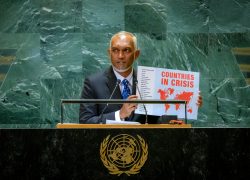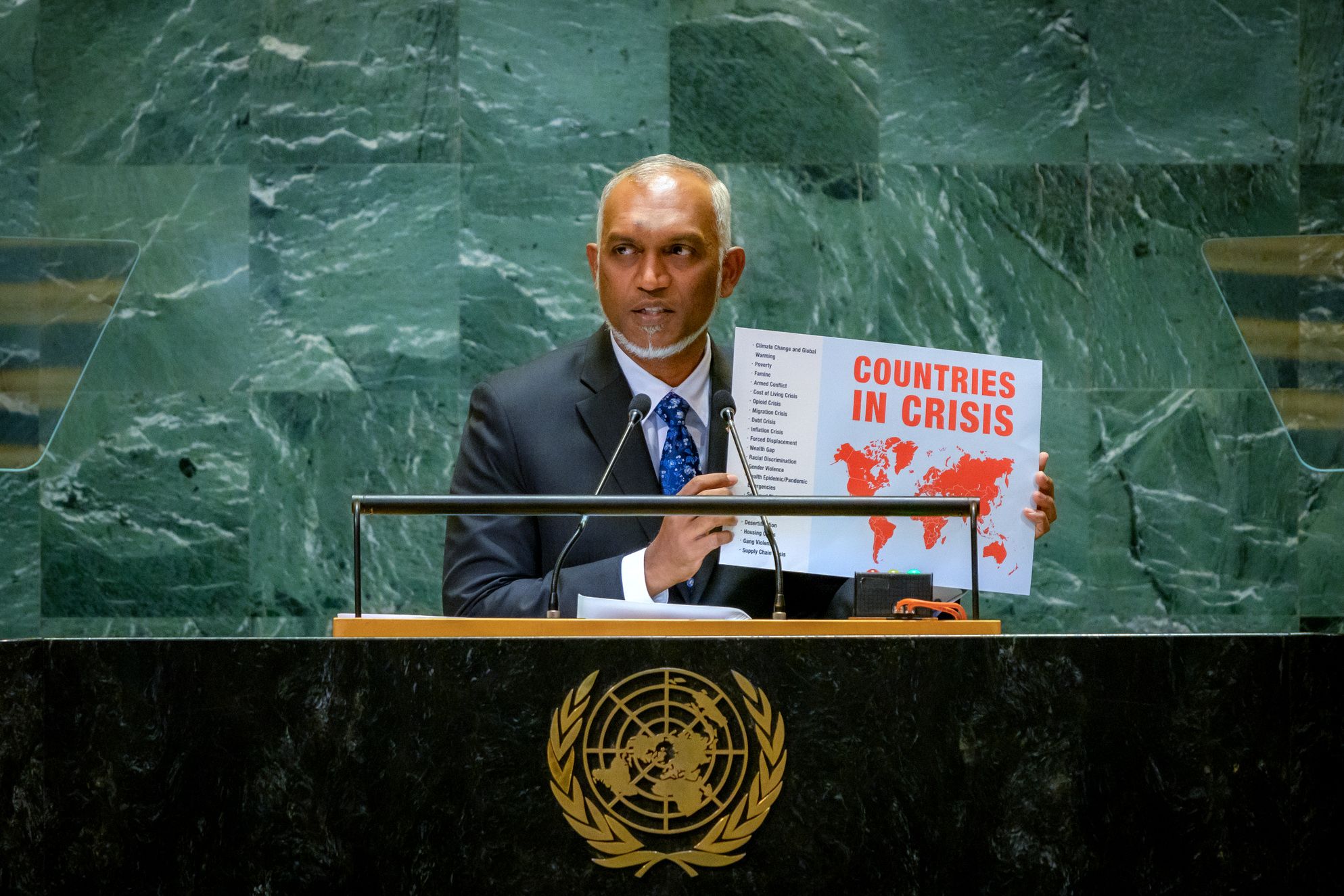

President Dr Mohamed Muizzu has reaffirmed the Maldives’ ambition to assume greater responsibility within the international community as the country marks 61 years since becoming a member of the United Nations, highlighting the nation’s transformation from a newly independent small island state into an increasingly active participant in global diplomacy.
In his message commemorating the anniversary, President Muizzu reflected on the Maldives’ journey since joining the United Nations on 21 September 1965, shortly after the country regained its independence. The Maldives was admitted to the organisation during the 20th Session of the UN General Assembly, beginning a relationship that has played an important role in the country’s development and international engagement over the past six decades.
President Muizzu said that when the Maldives joined the United Nations in 1965, the country entered the organisation seeking international recognition, cooperation and partnership. More than six decades later, he said the Maldives has reached a stage where it is prepared to shoulder greater responsibility in shaping the future of the United Nations and contributing to a more resilient, inclusive and sustainable global community.
The President reaffirmed the Government’s commitment to meaningful reform of the United Nations, including greater and more equitable representation within international decision-making structures. For the Maldives, he said, strengthening the multilateral system remains especially important for Small Island Developing States, whose circumstances and vulnerabilities require greater consideration in global policymaking.
A central priority of the Maldives’ international engagement continues to be ensuring that the concerns of Small Island Developing States are reflected in discussions on economic development, climate resilience, international finance and sustainable development. The Government has consistently advocated for stronger participation by smaller countries in international institutions and for a multilateral system in which countries have meaningful opportunities to contribute regardless of their geographical size or population.
President Muizzu stressed that the Maldives would continue working with the United Nations to ensure the perspectives of Small Island Developing States contribute to shaping an equitable and climate-resilient global economy. For an island nation with communities dispersed across the Indian Ocean, climate resilience and sustainable economic development remain closely linked to long-term national prosperity.
The President highlighted climate resilience, sustainable approaches to debt and debt sustainability, and better access to adequate and affordable international financing among the priorities the Maldives will continue to advance. He also emphasised the importance of improving access to climate adaptation finance and expanding opportunities for Small Island Developing States to strengthen their institutional, technical and human capacities.
These priorities are increasingly significant as island economies seek to balance ambitious development programmes with the considerable financial requirements associated with infrastructure, climate adaptation and economic resilience. The Government has maintained that development financing frameworks should better recognise the structural characteristics of Small Island Developing States and provide countries such as the Maldives with the financial space required to invest in long-term resilience.
Reflecting on the Maldives’ six decades of partnership with the United Nations, President Muizzu also recognised the organisation’s contribution to the country’s development journey. The Maldives progressed from Least Developed Country status and has developed into an upper-middle-income economy, with the United Nations and its agencies contributing across different stages of the country’s social, institutional and economic development. UN representatives have previously noted that the Maldives was the third country to graduate from Least Developed Country status.
President Muizzu said the partnership with the United Nations continues to hold importance as his administration works towards its national ambition of transforming the Maldives into a fully developed nation by 2040. The President has positioned the 2040 objective as a long-term national development goal centred on stronger productive capacity, economic diversification, technological advancement, digital transformation, sustainability and greater resilience.
The Maldives has also expanded its participation across the UN system in recent years. The country served as one of the Vice-Presidents of the 80th Session of the United Nations General Assembly, a role covering the September 2025 to September 2026 session and providing the Maldives with an opportunity to contribute at the leadership level of the General Assembly.
The Maldives has similarly held leadership responsibilities at the United Nations Human Rights Council. The country completed its third term as a member of the Council for 2023–2025, while its Permanent Representative in Geneva served as a Vice-President of the Human Rights Council in 2025 representing the Asia-Pacific Group. The Maldives has since announced its candidature for membership of the Human Rights Council for the 2028–2030 term, continuing its efforts to maintain an active presence in international human rights institutions.
The country has further strengthened its representation within other major UN bodies. The Maldives began its first-ever term on the United Nations Commission on the Status of Women in March 2026, with its membership continuing through 2030. Its participation provides the country with an additional platform to contribute its national experience and the perspectives of Small Island Developing States to international discussions.
Another major step in the Maldives’ international engagement came in June 2026 when the country was elected for the first time to the United Nations Economic and Social Council for the 2027–2029 term. The three-year membership will begin on 1 January 2027 after the Maldives secured 183 votes at the UN General Assembly election, providing the country with a broader role in discussions concerning sustainable development, financing and international economic and social cooperation.
The Maldives is also pursuing membership of the United Nations Security Council as a non-permanent member for the 2033–2034 term. The candidature reflects the country’s longer-term objective of increasing the representation of small states within major international decision-making institutions and contributing to discussions on international peace and security.
The expansion of the Maldives’ participation across these institutions reflects a wider foreign policy focus on strengthening the country’s voice internationally while ensuring that issues affecting small island nations receive greater attention within global forums. Climate vulnerability, development financing, debt sustainability and equitable representation remain particularly important areas in which the Maldives has sought to bring the experiences of island states into international discussions.
Reaffirming the country’s commitment to international law and the principles of the United Nations Charter, President Muizzu emphasised the importance of diplomacy, dialogue and inclusive multilateral governance at a time when the international community is confronting increasingly complex economic, environmental and geopolitical challenges.
As the Maldives marks 61 years of United Nations membership, the President’s message places the country’s next phase of international engagement around greater participation, stronger representation for Small Island Developing States and a continued commitment to constructive multilateral cooperation. From joining the United Nations as a newly independent island nation in 1965 to taking on responsibilities across major UN institutions, the Maldives continues to expand its diplomatic presence while pursuing its broader national development vision for 2040.
 advertisment



 advertisment