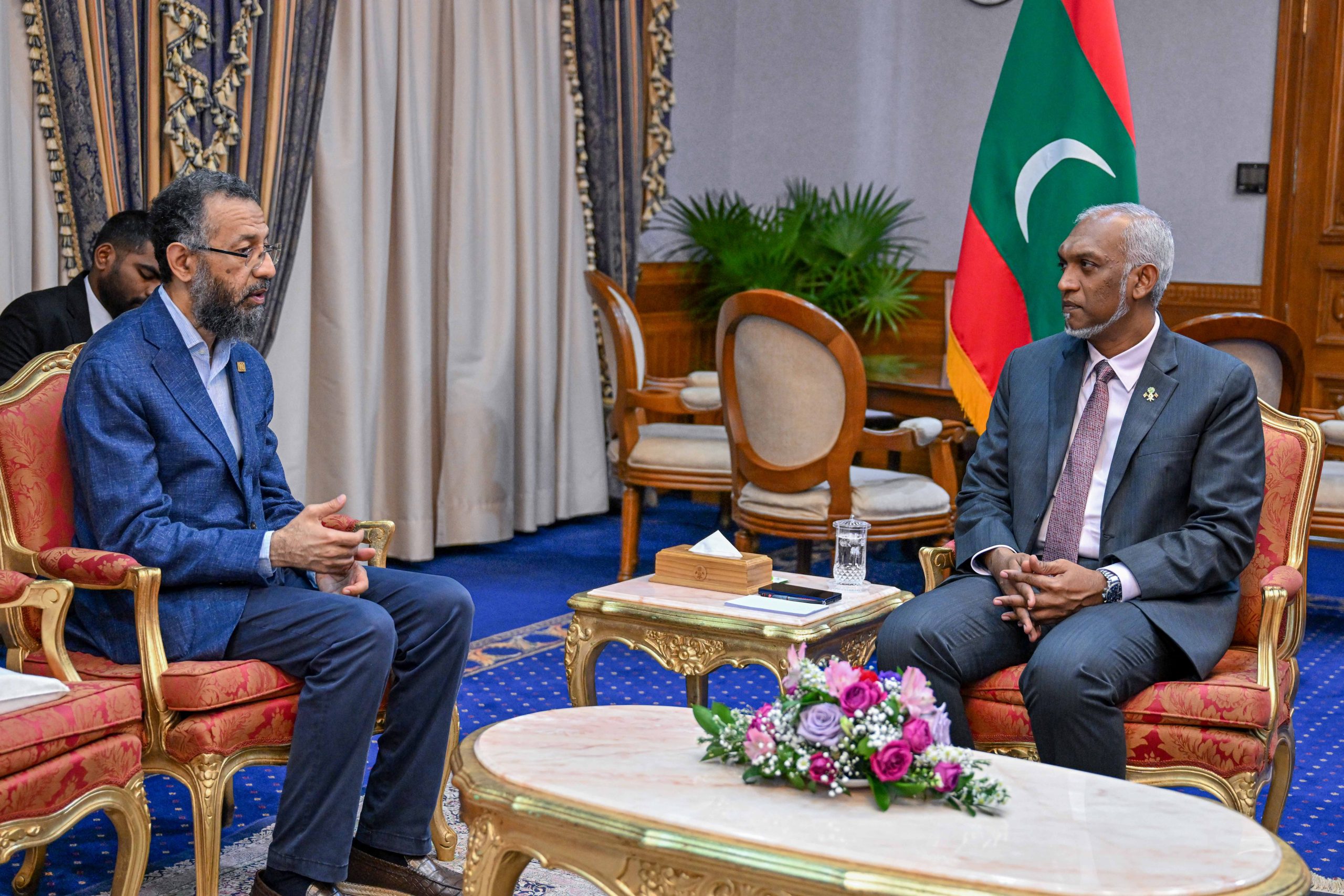

President Dr Mohamed Muizzu and the Secretary General of the Islamic Chamber of Commerce and Development (ICCD), Sheikh Yousef Hassan Khalawi, have discussed strengthening investment cooperation in the Maldives’ tourism and halal business sectors, with particular attention given to expanding the Islamic economy and developing new opportunities for international partnerships.
The discussions were held during a meeting at the President’s Office and reflected the Government’s continued efforts to broaden the Maldives’ economic partnerships, attract investment and identify new areas of growth that complement the country’s established strengths in tourism, services and international trade.
President Muizzu and Sheikh Yousef discussed opportunities to increase investment and cooperation in tourism and halal-related industries, while also exploring measures to strengthen institutional capacity and support the wider development of the Islamic economy. The discussions included the potential expansion of halal tourism, an area that offers the Maldives further opportunities to diversify its tourism portfolio and respond to the evolving preferences of travellers from Muslim-majority markets and other international destinations.
The Maldives is already recognised globally as one of the world’s leading luxury tourism destinations, supported by an extensive network of island resorts, hotels, guesthouses and tourism service providers. The country’s unique one-island-one-resort model, strong international air connectivity and globally recognised hospitality industry provide a substantial foundation for developing additional tourism products tailored to different market segments.
Greater development of halal-friendly tourism could complement the Maldives’ existing tourism industry by creating additional options for travellers seeking services aligned with Islamic values. This could include investment in tourism properties, hospitality services, food production and certification, family-oriented tourism experiences and other supporting businesses connected to the wider halal economy.
Such development also has the potential to strengthen the Maldives’ appeal across important markets in the Middle East, Southeast Asia and other regions with growing demand for halal-certified products and services. Expanding these opportunities could support the Government’s broader objective of attracting diversified international investment while maintaining the Maldives’ position as a premium global destination.
The meeting also focused on capacity-building and the importance of developing the skills, institutional expertise and business environment required to support sustainable growth in the Islamic economy. Greater cooperation with international Islamic economic institutions could provide Maldivian businesses with access to expertise, investment networks, business partnerships and opportunities in markets across the Islamic world.
The halal economy extends beyond tourism and includes sectors such as food production, hospitality, finance, logistics, manufacturing, pharmaceuticals, cosmetics, technology and professional services. Strengthening the Maldives’ participation in these sectors could create opportunities for local entrepreneurs and small and medium-sized enterprises while providing additional avenues for international investors seeking partnerships in a strategically located Indian Ocean economy.
The Government has continued to place emphasis on expanding economic opportunities, strengthening foreign investment and developing new industries alongside the country’s core tourism sector. Cooperation with organisations representing businesses across Muslim countries could further assist the Maldives in connecting domestic enterprises with larger international markets and investment networks.
During the meeting, Sheikh Yousef presented President Muizzu with a handwritten copy of the Holy Qur’an as a gift, marking the occasion and reflecting the close cultural and religious ties shared among member countries of the Organisation of Islamic Cooperation.
The Islamic Chamber of Commerce and Development is an international association operating under the Organisation of Islamic Cooperation and represents private-sector businesses and businesspeople from 57 Muslim countries. The organisation was previously known as the Islamic Chamber of Commerce, Industry and Agriculture.
Established in 1977, the ICCD works to strengthen trade, economic and industrial cooperation among Muslim countries and to promote greater private-sector engagement across OIC member states. Its areas of focus include facilitating investment, supporting the development of the halal economy, strengthening business connections and providing assistance to small and medium-sized enterprises.
The organisation also provides an important platform for connecting chambers of commerce, investors, entrepreneurs and private-sector institutions across its member countries, creating opportunities for cross-border partnerships and greater economic integration.
The Maldives is represented in the association by the Maldives National Chamber of Commerce and Industry, which provides a link between the country’s private sector and the wider network of businesses and chambers represented by the ICCD.
Closer engagement between the Maldives and the ICCD could open further opportunities for Maldivian companies to establish partnerships with businesses across OIC member countries while providing international investors with greater exposure to opportunities available in the Maldives.
With tourism remaining the principal pillar of the Maldivian economy, expanding complementary areas such as halal tourism, Islamic finance and halal-related businesses could contribute to greater economic diversification and strengthen the country’s competitiveness in emerging international markets.
The discussions between President Muizzu and Sheikh Yousef underline the potential for deeper economic cooperation between the Maldives and the broader Islamic business community, particularly as the Government continues to position the country as an attractive destination for investment, tourism development and international commercial partnerships.
 advertisment



 advertisment