
The Maldives is intensifying efforts to develop mariculture as a strategic growth sector, reflecting the government’s broader vision to diversify the national economy and create new income-generating opportunities for communities across the islands. As a small island nation with 99 percent of its territory consisting of ocean, the country is uniquely positioned to harness the economic value of its marine resources in a sustainable manner. With tourism long serving as the main pillar of the economy, the government is now placing increased emphasis on marine cultivation as an industry with strong potential to widen economic participation, stimulate entrepreneurship, and generate long-term benefits for the public.
To support this national objective, the government has introduced an integrated framework that combines financial assistance, technical training, and infrastructure investment to accelerate the development of the mariculture sector. The initiative is designed to create a supportive environment for private sector participation while laying the foundation for the Maldives to emerge as a recognized centre for sustainable marine cultivation in the Indian Ocean region. By linking financing with practical training and clearly designated development zones, the administration is advancing a structured approach that aims to make mariculture both commercially viable and environmentally responsible.
A key component of this effort is the newly established Mariculture Scheme, through which SME Digital has already disbursed loans amounting to USD 31,127 to support entrepreneurs entering the marine hatchery sector. The financing programme is intended to encourage new business activity and help local investors participate in a field that offers promising prospects for growth. Under the scheme, the government is targeting the financing of 200 fish pens across selected zones, providing substantial support to businesses at the operational level. Individual financial assistance under the programme ranges from USD 5,187 to USD 41,502, offering flexibility for enterprises of different scales and investment needs.
The repayment structure of the scheme has also been designed with the realities of a developing industry in mind. Beneficiaries are granted a maximum repayment period of six years, including an initial grace period of six months. This arrangement gives entrepreneurs valuable time to establish their operations, begin production, and build revenue streams before assuming full repayment responsibilities. Such a financing model is expected to reduce early-stage financial pressure and improve the ability of new businesses to enter the sector with greater confidence and stability.
In parallel with the financing programme, the government has identified several locations for mariculture development, including areas in the southern atolls as well as Raa Atoll, Meemu Atoll, and Thaa Atoll. These areas have been selected to support the expansion of marine cultivation activities in a systematic and regionally balanced manner. In addition, a lagoon located approximately two kilometres from Maaniyaafushi has been designated as a dedicated mariculture zone, further strengthening the infrastructure needed to facilitate organized and scalable industry growth. The designation of specific zones reflects a practical and forward-looking approach to resource management, providing clarity for investors and helping ensure that future expansion is aligned with national planning priorities.
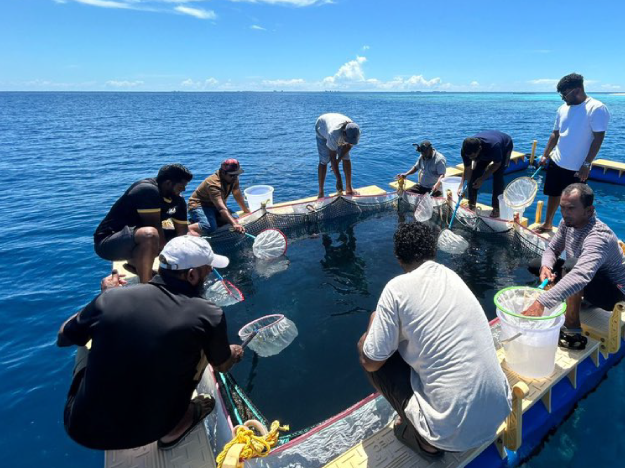
The government has also recognized that sustainable growth in mariculture requires more than capital investment alone. To ensure that the industry is supported by a capable and skilled workforce, the Marine Hatchery Skills Development Programme has been launched as a vocational initiative jointly implemented by the Ministry of Fisheries, Agriculture and Ocean Resources and the Maldives Marine Research Institute. The programme is being delivered with technical support from the World Bank-funded Transforming Fisheries Sector Management in South-West Indian Ocean Region and Maldives Project, highlighting the importance of international cooperation in supporting the country’s blue economy ambitions.
This skills development programme is focused particularly on young people across the islands, equipping them with specialized knowledge and practical competencies in marine hatchery operations. By investing in human capital, the initiative aims to create a reliable pipeline of trained personnel who can contribute directly to the expansion of the industry. This is expected to open new professional pathways for youth, support livelihoods in island communities, and encourage broader participation in an emerging sector that holds long-term promise for national development.
Taken together, these measures reflect a clear commitment by the Maldives to build a modern mariculture industry that contributes to economic resilience, environmental stewardship, and inclusive growth. With targeted financing, designated development zones, and structured vocational training now being advanced in tandem, the country is taking important steps to transform its vast marine space into a productive economic asset. For global observers, the Maldivian approach presents a meaningful example of how island nations can leverage their ocean resources thoughtfully and strategically to build a more diversified and sustainable economic future.
 advertisment



 advertisment