
A national policy on agroforestry has been formulated and formally handed over to the Ministry of Agriculture and Animal Welfare, marking an important step toward reshaping agricultural practices in the Maldives through a model that balances economic growth with environmental stewardship. Titled the “National Policy on Agroforestry and Trees Outside Forests 2026,” the framework was developed by the Ministry of Agriculture and Livestock in collaboration with World Agroforestry (ICRAF) and the Center for International Forestry Research (CIFOR–ICRAF), reflecting a coordinated approach that draws on international expertise and local priorities to address the country’s agricultural and ecological needs.
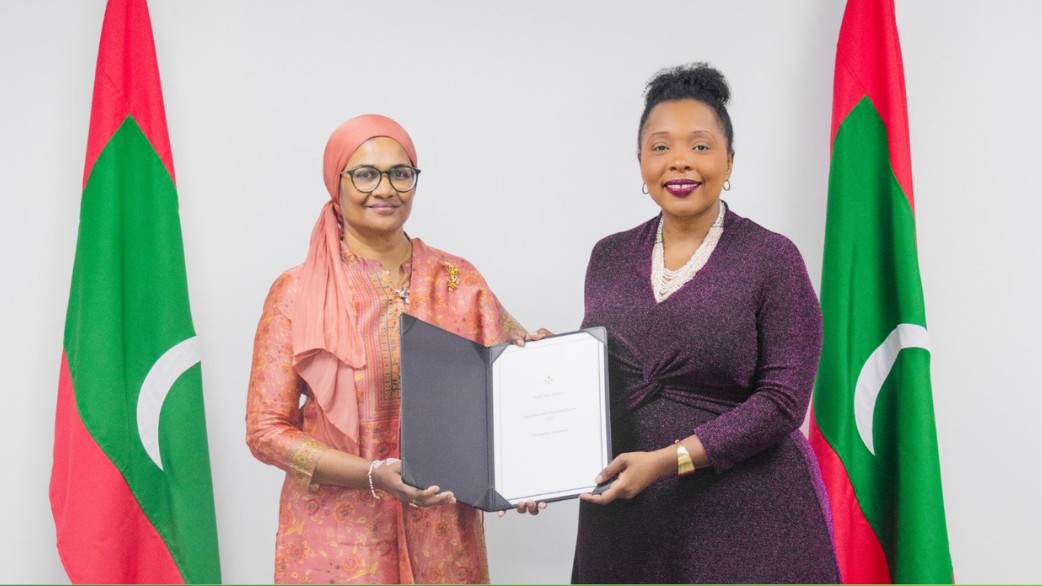
The policy was officially handed over by Dr Elian Ubalijuro, Director General of World Agroforestry, to Maryam Mariya, Minister of Agriculture and Animal Welfare, underscoring the Government’s commitment to strengthening sustainable agriculture across the nation’s islands. According to the Ministry, the primary objective is to establish an agricultural system that delivers both economic and environmental benefits by reviving and expanding the presence of trees in farmland and residential areas throughout the Maldives. By focusing on the integration of trees into productive landscapes, the policy aims to enhance soil health, improve resilience to extreme weather, and support more stable agricultural outputs over time, while also reinforcing natural habitats that are essential to island ecosystems.
Recognising the Maldives’ unique environmental conditions and soil-related challenges, the policy places particular emphasis on safeguarding reeds and coastal vegetation, which play a critical role in protecting shorelines and supporting biodiversity. The framework positions agroforestry as a practical tool for advancing agricultural development while contributing to vegetation regeneration, highlighting the value of keeping standing trees within farming areas rather than clearing tall vegetation. This approach contrasts with prevailing practices where land is often cleared through cutting down trees, and it signals a shift toward methods designed for long-term productivity and ecological balance, particularly important for small island environments that are highly sensitive to land degradation and climate impacts.
The policy further outlines how agroforestry can support national priorities on climate action and food security by promoting farming systems that are more resilient to climate-related pressures. By integrating crops with standing trees, agroforestry can contribute to buffering farms from wind and salt exposure, improving moisture retention, and supporting diversified yields, helping communities better manage risks while strengthening domestic food production potential. In this context, the policy frames agroforestry as part of a broader response to environmental and economic pressures, with an emphasis on sustainable development that protects natural assets while improving livelihoods.
Under the policy’s vision, agriculture is expected to evolve into a climate-adapted and sustainable livelihood, supported by incentives to empower agriculture-related associations and encourage wider tree planting. The policy also highlights the use of scientific research to revive and sustainably utilise indigenous plant species found in the Maldives, aiming to ensure that local biodiversity is not only protected but also valued as a productive resource for communities. The Ministry said the policy is expected to contribute to environmental protection while increasing agricultural productivity, with potential long-term economic benefits for the country as sustainable practices reduce environmental costs and strengthen agricultural output over time.
Agroforestry, as defined under the policy, refers to agricultural practices that integrate crops with standing trees without clearing tall vegetation, supporting environmental protection and long-term sustainability. As the Maldives advances this national framework, the policy is expected to guide practical changes across islands encouraging the restoration of trees within farms and residential areas, strengthening coastal protection through vegetation preservation, and building a more resilient agricultural sector aligned with the country’s climate and food security goals.
 advertisment


 advertisment