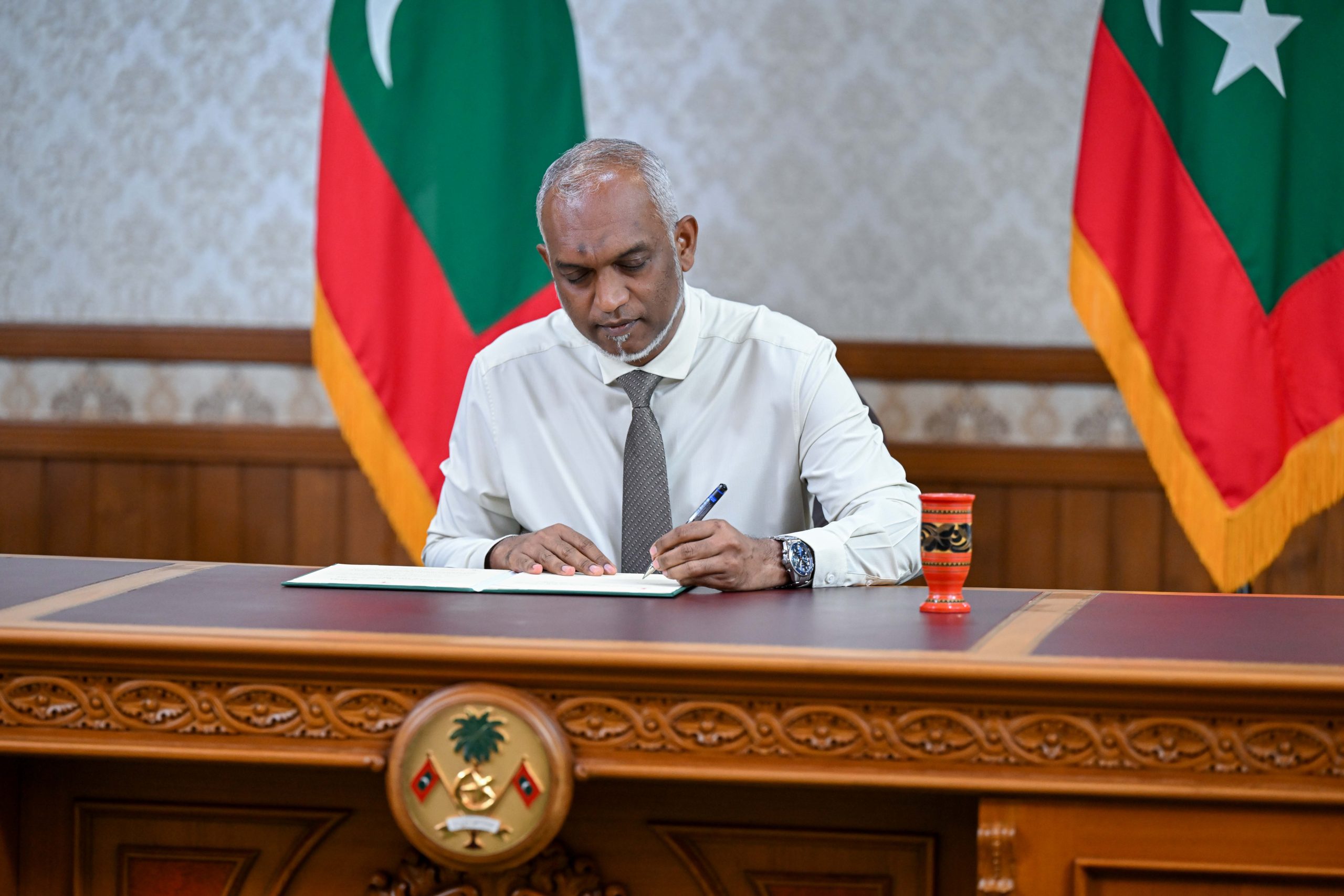

President Dr Mohamed Muizzu has outlined a long-term national strategy to gradually reduce the Maldives’ dependence on foreign currency and establish a stronger financial system in which the Maldivian Rufiyaa (MVR) plays a more central role in domestic economic activity.
Speaking on the country’s economic outlook, President Muizzu said achieving a predominantly MVR-based financial framework would require a carefully structured and phased transition spanning approximately 10 years. He emphasised that the process cannot be implemented abruptly, as the Maldivian economy remains closely connected to international investment, foreign financing, sovereign and commercial borrowing, and other financial commitments denominated in foreign currencies.
“This is not something that can be done overnight. It is interconnected with investments made in the Maldives, loans, and all similar commitments. It is estimated that taking it all the way to that point will take a 10-year period,” President Muizzu said.
The President said strengthening the role of the national currency has been a long-standing economic objective pursued by successive administrations, but noted that meaningful reform requires careful planning, strong institutional coordination and an approach that protects economic stability throughout the transition period.
The Maldives currently operates within a highly open financial environment where foreign currencies, particularly the US dollar, play a significant role in everyday commercial activity. The dollar is widely used across several areas of the economy alongside the Maldivian Rufiyaa, reflecting the country’s strong exposure to international tourism, foreign investment, imports and external financial transactions.
President Muizzu highlighted that this structure differs from the financial systems of many other countries, where foreign currency entering the economy is generally converted into the national currency before being used for domestic transactions. The widespread circulation of foreign currency within the Maldives therefore means that any structural adjustment must be introduced gradually to avoid unnecessary pressure on businesses, investors, financial institutions and the wider economy.
The Government’s longer-term approach is expected to focus on progressively expanding the use and circulation of the Maldivian Rufiyaa while strengthening the mechanisms required to support confidence in the national currency. This includes ensuring that reforms are aligned with the country’s international financial obligations and the operational requirements of key economic sectors.
President Muizzu said economic priorities would need to be categorised and assessed systematically, with financial institutions and other relevant stakeholders working together throughout the transition. Such coordination would allow policy changes to be introduced progressively while preserving stability and providing sufficient time for businesses and institutions to adapt.
The proposed 10-year timeframe reflects the Government’s emphasis on implementing structural economic reforms in a measured and sustainable manner rather than pursuing rapid changes that could create disruption in a highly internationally connected economy.
For the Maldives, where tourism, international trade, infrastructure investment and external financing remain major contributors to economic activity, strengthening the domestic currency is closely linked to broader efforts to improve financial resilience and economic independence. A greater role for the Rufiyaa in domestic transactions could also contribute to improving monetary management and reducing the economy’s exposure to fluctuations in foreign currency availability over the longer term.
The administration’s strategy reflects its broader focus on strengthening the country’s financial foundations while maintaining an environment supportive of international investment and economic growth. By approaching the transition through a clearly defined multi-year framework, the Government aims to progressively enhance the role of the Maldivian Rufiyaa while safeguarding the stability of businesses, financial institutions and the wider economy.
President Muizzu said the ultimate objective is to establish a more resilient domestic financial system in which the national currency assumes a stronger position, supporting greater economic sovereignty and creating a more sustainable financial framework for the Maldives over the coming decade.
 advertisment




 advertisment