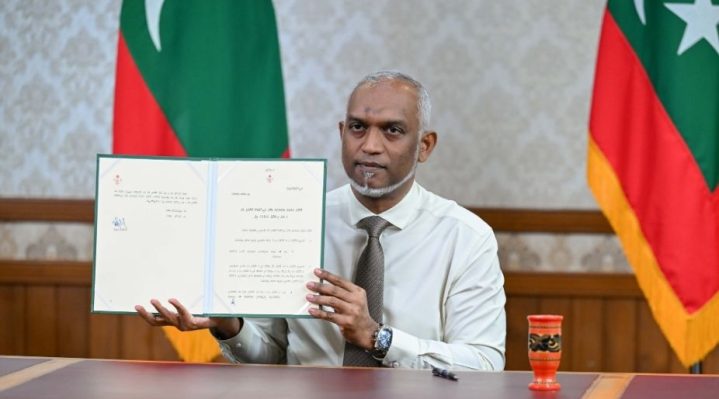

President Dr Mohamed Muizzu has ratified seven major pieces of legislation covering foreign currency management, taxation, tourism, land use, transport and fisheries, advancing the Government’s broader programme to strengthen economic governance, improve revenue mobilisation and establish clearer regulatory frameworks across key sectors of the Maldivian economy.
The legislative package, ratified during a single ceremony on Monday, includes significant reforms affecting the country’s internationally important tourism industry, particularly resort operators, foreign tourism intermediaries and businesses generating substantial foreign currency earnings. The reforms also strengthen the powers of the Maldives Inland Revenue Authority (MIRA), introduce new rules governing foreign currency transactions and modernise regulatory frameworks for land transport, uninhabited islands, aquaculture and fisheries.
Among the most significant measures is the amendment to the foreign currency framework, which takes effect on 1 September 2026. Under the revised system, Category A tourism establishments, including resorts, will be required to convert 40 per cent of their monthly gross sales through a bank licensed by the Maldives Monetary Authority (MMA), replacing the previous option of converting USD 500 per tourist.
The new requirement gives the Government and monetary authorities a more structured mechanism for ensuring that a larger share of the foreign currency generated by the tourism industry circulates through the domestic banking system. As resorts account for a substantial share of the Maldives’ foreign exchange earnings, the policy is expected to increase the availability of foreign currency through official banking channels and support broader efforts to strengthen foreign exchange management.
Maldives’ resort sector remains the central pillar of the country’s tourism economy, attracting travellers from major international markets and generating substantial foreign currency revenue through accommodation, dining, recreation, transfers and other visitor services. Resort operations also support a wide domestic economic ecosystem, including transport providers, food suppliers, construction companies, service businesses and thousands of Maldivian employees.
The Government’s revised foreign currency framework therefore places resorts at the centre of its efforts to improve foreign currency circulation and strengthen monetary stability. While resort operators maintain significant operational commitments in US dollars, including international procurement, financing arrangements, utilities, maintenance and overseas payments, the Government has structured the new framework around monthly gross sales to create a consistent inflow of foreign currency into licensed financial institutions.
Category B tourism establishments will be permitted to convert either USD 25 per tourist or 20 per cent of their monthly gross sales. Businesses outside the tourism industry earning more than USD 25 million annually in foreign currency will also be required to convert 40 per cent of monthly gross sales. For businesses that are entirely Maldivian-owned, the conversion requirement will be reduced to seven per cent.
Foreign currency subject to the requirement must be deposited into a foreign currency account maintained with an MMA-licensed bank and converted by the 28th day of the following month, establishing a defined and predictable monthly compliance mechanism for businesses.
The amendment also strengthens regulation of unofficial foreign currency trading. Selling or attempting to sell foreign currency outside rates or bands determined by the MMA will constitute an offence, while advertising or promoting unauthorised foreign currency transactions will also be subject to enforcement action.
The legislation defines advertising and promotion broadly enough to include the publication or circulation of exchange-rate information where it is used to advertise, encourage or facilitate unauthorised transactions. Individuals conducting unlawful foreign currency transactions may face fines ranging from MVR 25,000 to MVR 1 million.
Individuals advertising or promoting unauthorised transactions may face penalties of up to MVR 500,000, while companies and other legal entities may be fined between MVR 100,000 and MVR 5 million. The provisions are intended to strengthen oversight of the foreign exchange market and encourage transactions to take place through regulated financial channels.
Some opposition representatives raised concerns during parliamentary consideration over how provisions relating to the publication of unofficial exchange rates could affect public discussion and reporting. The Maldives Association of Tourism Industry also expressed reservations regarding the 40 per cent conversion requirement, pointing to the substantial foreign currency expenses and debt obligations carried by resort operators.
Alongside the foreign currency reforms, the Government has expanded the tourism taxation framework by bringing qualifying services sold through offshore booking platforms, overseas travel agents and foreign tour operators within the scope of the Maldives’ 17 per cent Tourism Goods and Services Tax.
The GST amendment applies the internationally recognised destination principle, under which applicable services are taxed according to where they are consumed rather than solely according to where the supplier is established. This means that qualifying tourism services ultimately consumed in the Maldives can fall within the domestic tax framework even when they are marketed or sold by companies operating abroad.
The scope includes inbound tourism products associated with accommodation, meals, transportation and other services supplied to international visitors travelling to the Maldives. The reform is particularly relevant to the resort industry, where a considerable proportion of international bookings is generated through global travel agencies, online booking platforms, wholesalers and tour operators based outside the country.
By extending taxation to qualifying offshore tourism intermediaries, the Government is seeking to create a more balanced tax environment between businesses operating within the Maldives and overseas entities earning revenue from Maldivian tourism products. It is also expected to strengthen revenue collection from the international tourism distribution network while ensuring that economic activity associated with Maldives-bound travel contributes appropriately to the national revenue system.
The Government estimates that the inclusion of foreign tourism intermediaries within the taxation framework could generate more than MVR 1.6 billion in additional annual revenue. Such revenue would further strengthen the State’s fiscal capacity at a time when the administration is pursuing measures to improve public finances, increase revenue mobilisation and support long-term economic sustainability.
The Maldives Association of Travel Agents and Tour Operators raised concerns during the legislative process regarding industry consultation, the complexity of international tourism distribution arrangements and the practical implementation of registration requirements for overseas businesses without a permanent physical presence in the Maldives. The GST amendment has nevertheless entered into force, with the Government required to publish the necessary regulatory amendments within 30 days.
Two additional laws expand the country’s tax administration and collection framework. An amendment to the Income Tax Act increases the withholding tax applied to payments made to non-resident contractors undertaking construction projects from five per cent to 10 per cent.
The withholding deduction will represent the contractor’s full and final tax liability, while revisions to the definition of non-resident contractors are intended to simplify tax filing requirements and improve administrative clarity.
An amendment to the Tax Administration Act gives MIRA wider authority in audits, investigations and the recovery of outstanding tax liabilities. The Commissioner General of Taxation will be empowered to require any party holding information necessary for the administration of tax laws to provide such information to MIRA.
The legislation also introduces additional tax offences and penalties, allows certain penalties to be settled through instalment arrangements and expands provisions governing cooperation with foreign tax authorities. This includes joint examinations, Country-by-Country Reporting and the Common Reporting Standard, strengthening the Maldives’ alignment with international tax transparency practices.
Failure to comply with obligations under the Common Reporting Standard may result in penalties of up to MVR 250,000.
The legislative package also introduces a new framework governing the use and leasing of uninhabited islands and standalone lagoons. The law replaces the previous uniform rental rate of 10 laari per square metre with rental rates determined according to the economic or social purpose for which the land is leased.
Annual rent will be set at MVR 3 per square metre for industrial and economic activities, MVR 2.50 per square metre for fisheries and agricultural activities, and MVR 2 per square metre for social purposes. Islands allocated under the traditional “varuvaa” arrangement will also carry an annual fee of MVR 2 per square metre.
Under the legislation, the President will designate islands and lagoons for specific categories of use, while local councils will generally be responsible for allocating uninhabited islands located within their administrative jurisdictions. Exceptions will apply to islands allocated for tourism development, industrial purposes or other State uses.
The new legislation will take effect 30 days after ratification and will replace the Uninhabited Islands Act of 1998, providing an updated framework for the productive utilisation of the Maldives’ land and lagoon resources.
Transport regulation will also undergo significant restructuring under the newly ratified Land Transport Act. The Greater Malé region will be designated as a Registration and Traffic Management Controlled Zone, with a dedicated Greater Malé Transport and Mobility Office responsible for overseeing transport management for an initial period of three years.
The office will have responsibilities relating to vehicle quotas, traffic management and public transportation, reflecting the Government’s efforts to address increasing vehicle numbers, congestion and mobility requirements across the densely populated Greater Malé region.
The law will generally limit the operational lifespan of vehicles to 20 years from their date of manufacture. Vehicles already exceeding the 20-year limit will receive a three-year transitional period before the restriction is fully applied.
During parliamentary consideration, opposition lawmakers raised concerns regarding provisions transferring certain transport responsibilities and associated revenue streams from local councils to central authorities. The legislation also provides for the establishment of a National Road Safety Council and a dedicated transport development fund.
The Land Transport Act will enter into force after 30 days and will repeal the existing Land Transport Act as well as the Maldives Pedestrian Act.
The seventh law ratified by the President amends the fisheries framework, expanding regulation of fishing and aquaculture activities in protected areas and creating a legal foundation for specialised fishing harbours.
The amendment also requires the development of new regulations governing recreational and sport fishing, revises arrangements for leasing aquaculture areas and strengthens legal procedures for responding to illegal fishing activities involving foreign vessels.
The provisions include mechanisms relating to the responsibilities of the flag states of foreign vessels, providing authorities with a clearer framework for addressing unlawful fishing activity in Maldivian waters. Fisheries authorities have been given 60 days to revise existing regulations and introduce the additional rules required under the amended legislation.
Four of the seven laws have taken effect immediately, while the foreign currency amendment comes into force on 1 September 2026. The legislation governing uninhabited islands and land transport will become effective after 30 days.
The package represents one of the Government’s broadest economic and regulatory reform programmes of the year, with particular significance for tourism, foreign currency management and public revenue. For the Maldives’ resort industry, the changes introduce a more structured relationship between tourism-generated foreign currency, the domestic banking system and the national tax framework, while the Government seeks to strengthen financial stability, improve regulatory oversight and ensure that growth in the country’s leading economic sectors contributes sustainably to the wider national economy.
 advertisment




 advertisment