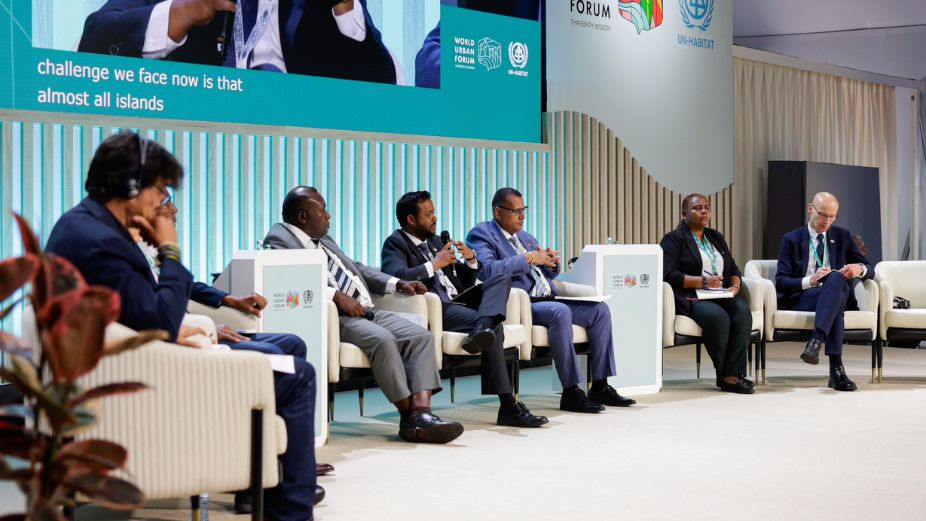

The Maldives has called for climate adaptation financing to become more accessible, responsive, and aligned with the realities faced by vulnerable nations, as the country continues to position housing, urban planning, and population distribution at the centre of its long-term resilience strategy. The appeal was made by Minister of Infrastructure, Housing and Urban Development Abdulla Mutthalib during engagements with UN-Habitat, the World Bank, and other international partners at the 13th World Urban Forum in Baku, which was held under the theme “Housing the World: Safe and Resilient Cities and Communities.”
During the high-level discussions, Minister Mutthalib outlined the Maldives’ priorities and challenges in the areas of climate adaptation, housing, and sustainable urban development, drawing attention to the distinct pressures faced by small island nations. He stressed that vulnerable countries require financing mechanisms that are not only available in principle, but also accessible in practice and delivered at the scale necessary to support meaningful adaptation. For countries such as the Maldives, where environmental exposure and development needs are closely interconnected, access to timely and adequate support remains essential to strengthening resilience and ensuring sustainable national progress.
The Minister’s engagements in Baku also included a bilateral meeting with Anacláudia Rossbach, United Nations Under-Secretary-General and Executive Director of UN-Habitat, where the Maldives further advanced its perspective on the relationship between climate resilience and urban development. In these discussions, Minister Mutthalib advocated for voluntary population consolidation to be recognised internationally as a legitimate climate adaptation measure. This issue carries particular importance for the Maldives, an archipelagic nation where communities are dispersed across numerous islands, creating significant cost and logistical challenges in delivering infrastructure, public services, and climate-resilient housing in a balanced and sustainable manner.
The Maldives used the forum to underscore that housing should be viewed not merely as a social necessity, but as essential resilience infrastructure for Small Island Developing States. This approach reflects a broader national policy direction that places safe, durable, and well-planned housing within the wider framework of climate security, economic stability, and social wellbeing. By linking housing development to resilience planning, the Maldives continues to present a forward-looking model that addresses immediate community needs while also responding to the growing risks posed by climate change.
As international discussions increasingly focus on how nations can adapt to rising environmental and economic pressures, the Maldives has continued to articulate the importance of integrating housing and urban development into the global climate adaptation agenda. The country’s message in Baku reflected a practical and policy-driven perspective: for vulnerable island states, resilient housing, efficient service delivery, and carefully planned urban development are not separate issues, but closely connected pillars of national sustainability. Through its participation at the World Urban Forum, the Maldives reinforced its commitment to working with international partners to advance solutions that are realistic, inclusive, and responsive to the needs of communities on the frontlines of climate change.
The Maldives’ contribution to the forum also highlighted the country’s growing role in shaping international dialogue on resilience and sustainable development. By bringing attention to the specific circumstances of geographically dispersed island communities, the country continues to advocate for a development framework that recognises both vulnerability and opportunity. Its call for more effective financing and greater recognition of locally relevant adaptation measures reflects a broader effort to ensure that global policymaking responds more equitably to the needs of nations facing the most immediate climate risks. For international observers, the Maldives’ position offers a clear example of how small states are contributing practical ideas and policy leadership to one of the world’s most urgent development challenges.
 advertisment



 advertisment