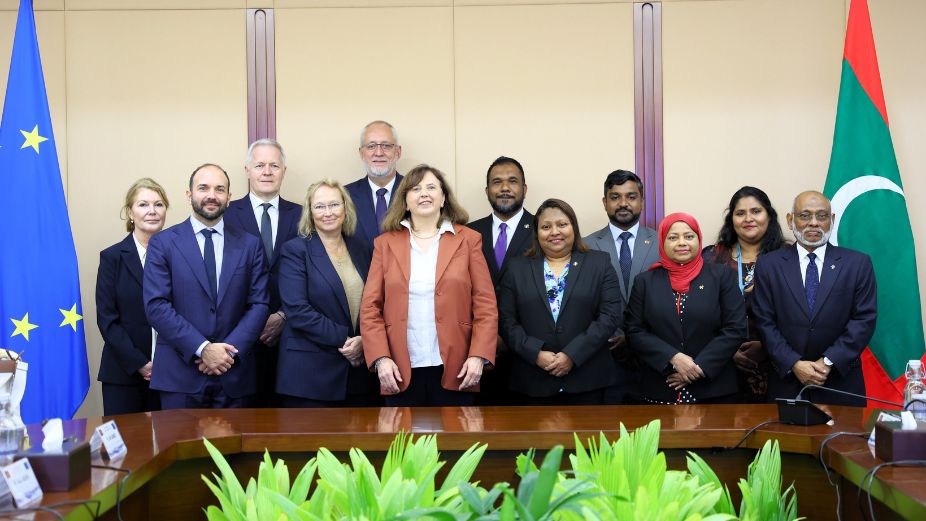

The Maldives and the European Union have formally elevated their bilateral engagement into a structured Partnership Dialogue framework, signalling a new chapter in relations that broadens cooperation beyond annual officials’ meetings into comprehensive political, economic and security collaboration. The first Maldives–European Union Partnership Dialogue was convened in Malé on 9 February 2026, reflecting the growing maturity of ties between the two sides and their shared commitment to strengthening institutional engagement.
The Dialogue builds on a series of Senior Officials’ Meetings held since 2020, while representing a significant institutional progression following the Maldives’ signing of the Samoa Agreement on 1 July 2024. The agreement has provided the legal and policy foundation for formalising dialogue under a more expansive partnership architecture, enabling both parties to engage on a wider spectrum of strategic priorities with increased continuity and depth.
High-level discussions encompassed democratic governance, human rights, climate action, maritime and regional security, trade, fisheries and people-to-people exchanges. Both sides reaffirmed their shared commitment to democratic principles and fundamental rights, including freedom of expression and the importance of preserving civic space for civil society organisations. The engagement underscored a mutual understanding that sustainable development and long-term stability are intrinsically linked to transparent institutions, accountable governance and inclusive participation.
Political and economic developments within both jurisdictions were reviewed in detail. Particular attention was given to infrastructure expansion, fiscal management, anti-corruption measures, digital transformation, education reform and economic diversification strategies. The Maldives expressed appreciation for the European Union’s continued support for democratic processes, including follow-up initiatives connected to the European Union’s Election Observation Missions, whose most recent mission concluded in November 2025. The EU indicated its readiness to sustain technical and institutional support in these areas, reinforcing collaborative efforts aimed at strengthening governance frameworks and public sector capacity.
The European Union also encouraged the Maldives to continue fulfilling its commitments as a signatory to the International Covenant on Civil and Political Rights, emphasising the importance of adherence to international obligations. At the same time, the Maldives acknowledged EU-backed capacity-building programmes, including maritime cooperation initiatives under the CRIMARIO programme, which contributes to enhancing maritime domain awareness and safeguarding critical sea lanes in the wider Indian Ocean region. Security cooperation emerged as a central pillar of the partnership, with both sides identifying practical avenues for deeper collaboration to address evolving regional challenges, including maritime safety and transnational threats.
Trade and economic cooperation formed a key component of the Dialogue. Discussions focused on expanding bilateral trade volumes and enhancing market access for Maldivian fish products within the European Union market. Both sides examined tariff-related considerations and domestic reform measures aimed at strengthening competitiveness, attracting foreign investment and supporting sustainable, long-term economic growth. The Dialogue highlighted the importance of maintaining predictable trade frameworks that benefit producers and consumers across both markets, while reinforcing the Maldives’ position as a reliable trading partner.
Climate and environmental cooperation featured prominently in the discussions, reflecting the Maldives’ status as one of the countries most vulnerable to climate change. The two sides expressed their commitment to finalising a financing agreement under the Annual Action Programme 2025 for a “Community-based Mangrove Protection and Rehabilitation in the Maldives” project. The proposed agreement is expected to allocate an additional EUR 4 million towards mangrove conservation, reinforcing national adaptation strategies and ecosystem resilience. The European Union also outlined its offer to provide Earth Observation data through its Copernicus satellite system, supporting evidence-based climate planning and environmental monitoring. In addition, new programmes aimed at countering the misuse of digital technologies by terrorist and criminal networks were discussed, further broadening the scope of cooperation into digital security and resilience.
During the Dialogue, the Maldives requested consideration for inclusion among countries exempt from Schengen visa requirements, highlighting the importance of facilitating mobility, educational exchanges, tourism flows and broader people-to-people engagement. The discussion reflected the shared interest in strengthening connectivity between Maldivian and European communities, businesses and institutions.
Regional developments in the Indo-Pacific were also addressed, with both parties reiterating their support for multilateralism and a rules-based international order centred on the United Nations. The Dialogue reaffirmed the importance of cooperative approaches to regional stability, maritime security and sustainable development across the wider Indian Ocean region.
The meeting was co-chaired by Foreign Secretary Fathimath Inaya and Paola Pampaloni, Deputy Managing Director for Asia and Pacific at the European External Action Service. The Dialogue concluded with a shared understanding that the discussions would be translated into concrete, results-oriented initiatives, and both sides indicated that the second Partnership Dialogue could be hosted in Brussels in 2027, ensuring continuity and sustained engagement under the new framework.
 advertisment


 advertisment