
Six Senses Kanuhura has announced the Kanuhura Coral Census, a pioneering marine conservation initiative designed to strengthen reef protection through long-term, high-precision monitoring, positioning the resort among the leading contributors to reef science in the Maldives. Developed in collaboration with scientists from Newcastle University and University College London (UCL), the programme introduces an advanced 3D reef-monitoring methodology that delivers exceptional accuracy, robust data integrity, and deeper ecological insight. The launch comes at a time of increasing urgency for coral ecosystems, with global research indicating that up to 90 percent of the world’s coral reefs could be lost by 2050, underscoring the importance of credible, scalable monitoring that can guide effective action.
For many decades, coral reef monitoring around the world has largely depended on diver observations supported by clipboards, tape measures, and manual recording. While these approaches have contributed meaningfully to understanding reef conditions, they are inherently constrained by time, subjectivity, and limited coverage, often capturing only a small fraction of a reef’s true complexity. Traditional surveys typically assess less than 0.01 percent of a given site, leaving large gaps in the data and making it difficult to build a complete, consistent picture of how reefs change over time particularly in dynamic environments such as the Maldives, where seasonal shifts and warming events can rapidly influence coral health.
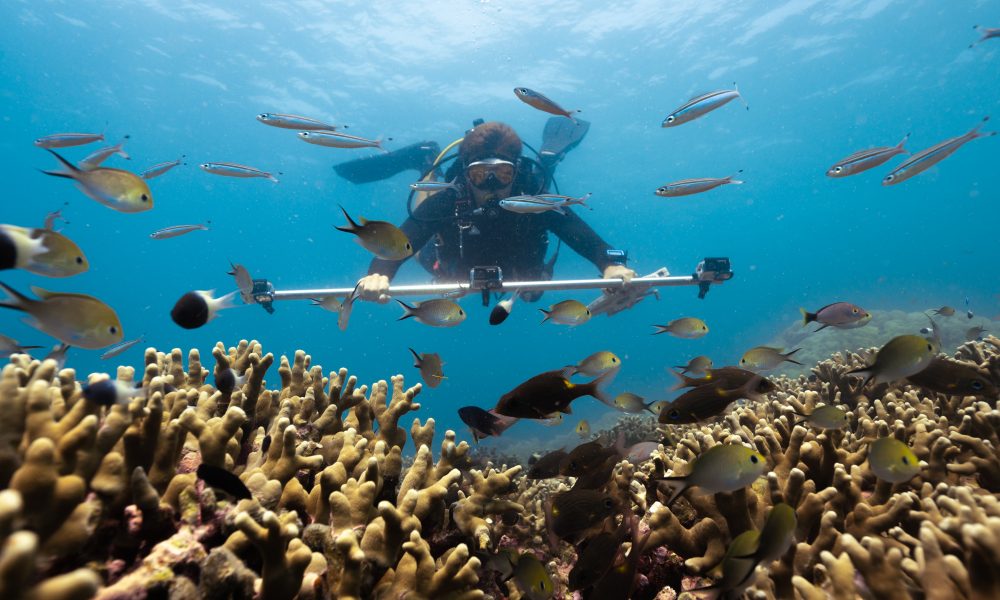
The Kanuhura Coral Census is designed to remove these limitations by combining 3D modelling with advanced AI analysis techniques, including Gaussian splatting, to create hyper-accurate digital reconstructions of reef sections. At each site, the system maps more than 100 square metres of reef and captures detail down to half a millimetre, producing a fully repeatable dataset that can be revisited and compared over time with scientific consistency. The operational efficiency of the methodology also supports wider monitoring potential, requiring only 20 minutes of diving to collect all images needed for each 3D model enabling frequent updates while reducing the field burden that can restrict conventional research.
By digitising entire reef sections in ultra-high resolution rather than relying on small snapshots, the programme offers a more comprehensive view of reef condition and structure, while AI-driven analysis helps remove human bias and ensure consistent coral data regardless of who conducts the survey. The level of ecological detail captured is equally significant, allowing the monitoring team to measure indicators such as rugosity, coral-canopy height, overhangs, and habitat complexity, features that are often overlooked or difficult to quantify using traditional methods but are critical for understanding biodiversity, shelter availability, and the reef’s overall resilience. This repeatability allows the same reef sections to be re-surveyed every few months, supporting what the resort describes as the Maldives’ most accurate time-series coral dataset and enabling more confident decision-making based on observable trends rather than partial impressions.
Beyond scientific measurement, the Kanuhura Coral Census is also designed to strengthen communication and transparency, using immersive 3D models that translate complex research into clear, intuitive visual insights for guests, researchers, and the wider public. This approach supports education and engagement by showing reef conditions in a way that is accessible and compelling, helping stakeholders understand both the fragility of reef ecosystems and the tangible outcomes of conservation work. As resorts increasingly play a role in sustaining the marine environments that define the Maldivian experience, initiatives that combine scientific rigour with public understanding can help build broader support for long-term reef protection.
Alicia Graham, General Manager of Six Senses Kanuhura, said the programme represents a significant step forward for reef science within the hospitality sector, explaining that it elevates how reefs are monitored while expanding what is possible in resort-led conservation. She noted that the methodology makes it possible to track even the smallest changes with scientific precision, share findings transparently, and make data-driven decisions that directly support reef recovery, describing the initiative as a new era of accountable and impact-driven conservation for the Maldives.
Looking ahead, the resort’s long-term objective is to use the detailed insights from the Coral Census to develop a next-generation restoration programme that shifts away from traditional metal frames and toward solutions that are more sustainable and ecologically informed. With the ability to identify which corals are thriving, struggling, recruiting, or bleaching and exactly where those patterns occur, Six Senses Kanuhura aims to design a restoration blueprint informed by real-world reef performance, setting a new benchmark for the region and reinforcing the Maldives’ position as a destination where world-class hospitality can also contribute meaningfully to global marine conservation.
 advertisment



 advertisment