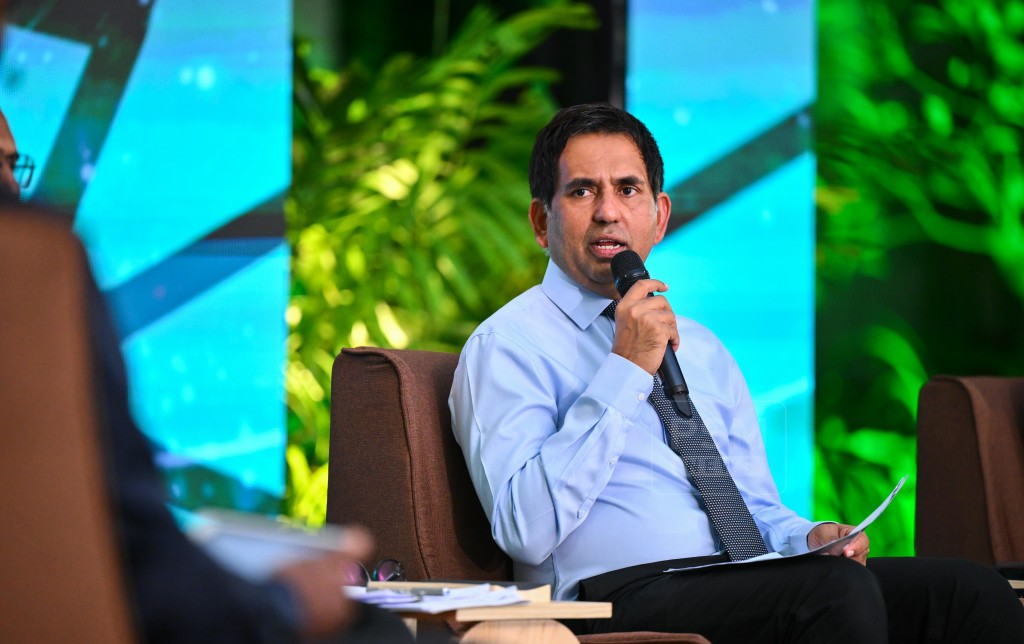

The Government has expanded its essential goods list to 80 products to safeguard supply and support public access to affordable necessities, Minister of Economic Development, Transport and Trade Mohamed Saeed said. He explained that the policy is intended to maintain availability and ease pressure on households, while supporting a market in which small businesses continue to operate.
Speaking at the eighth edition of the Ahaa Forum, organised jointly by the President’s Office and Public Service Media, Minister Saeed said essential food items remain readily available in the Maldives. He highlighted the Government’s focus on preventing shortages despite financial and external challenges affecting the country.
The Minister said President Dr Mohamed Muizzu assumed office amid a large inherited debt burden. He also cited the ongoing war in the Gulf and the Maldives’ dollar shortage as challenges the Government has had to address while prioritising measures to avoid passing additional burdens on to the public.
According to Saeed, the revision of the essential goods list forms part of that response. The Government has introduced measures intended to maintain a continuous supply of products and ensure that key categories remain accessible at the best possible prices under prevailing market conditions.
“The President particularly wanted the Government to ensure that certain categories of products are easily available to the public at the best possible prices, rather than directly competing with businesses over individual products,” the Minister said.
Saeed addressed concerns about the policy’s implications for smaller enterprises, stressing that direct competition with individual small businesses is not its purpose. He said viewing the measures solely through that perspective could create misunderstanding about the Government’s objectives.
The Minister noted that the State Trading Organisation supplies 10 types of vegetables, 10 types of fruit and six additional food products to the market at the best prices available at the time. He explained that the essential goods list previously comprised 26 product types and remains subject to ongoing review.
The expanded list now covers 80 product types monitored by the Government. The vegetable category has increased from 10 to 20 types, while the addition of 10 fruit types has brought that category to 20. A further 37 types of other products include items needed by young children and older people, alongside three types of non-food goods.
The broader coverage reflects an effort to address a wider range of everyday needs. Including products relevant to different age groups extends the policy’s reach across households, while regular monitoring provides a basis for reviewing availability and responding to supply concerns.
Saeed said STO outlets in Malé and the atolls make these products available at both wholesale and retail levels, with favourable prices determined by prevailing market conditions. Wholesale access provides a supply channel for businesses, while retail availability allows consumers to purchase directly from STO outlets.
The Minister also encouraged the public to use the AguMagu portal to compare prices and identify shops offering products at lower rates. The portal gives consumers access to information that can help them make more informed purchasing decisions.
The expansion places supply continuity, affordability and price transparency at the centre of the Government’s approach to essential goods. Through a wider monitored list, wholesale and retail distribution, and access to price comparisons, the measures aim to help households obtain everyday necessities while maintaining reliable market supply.
 advertisment




 advertisment