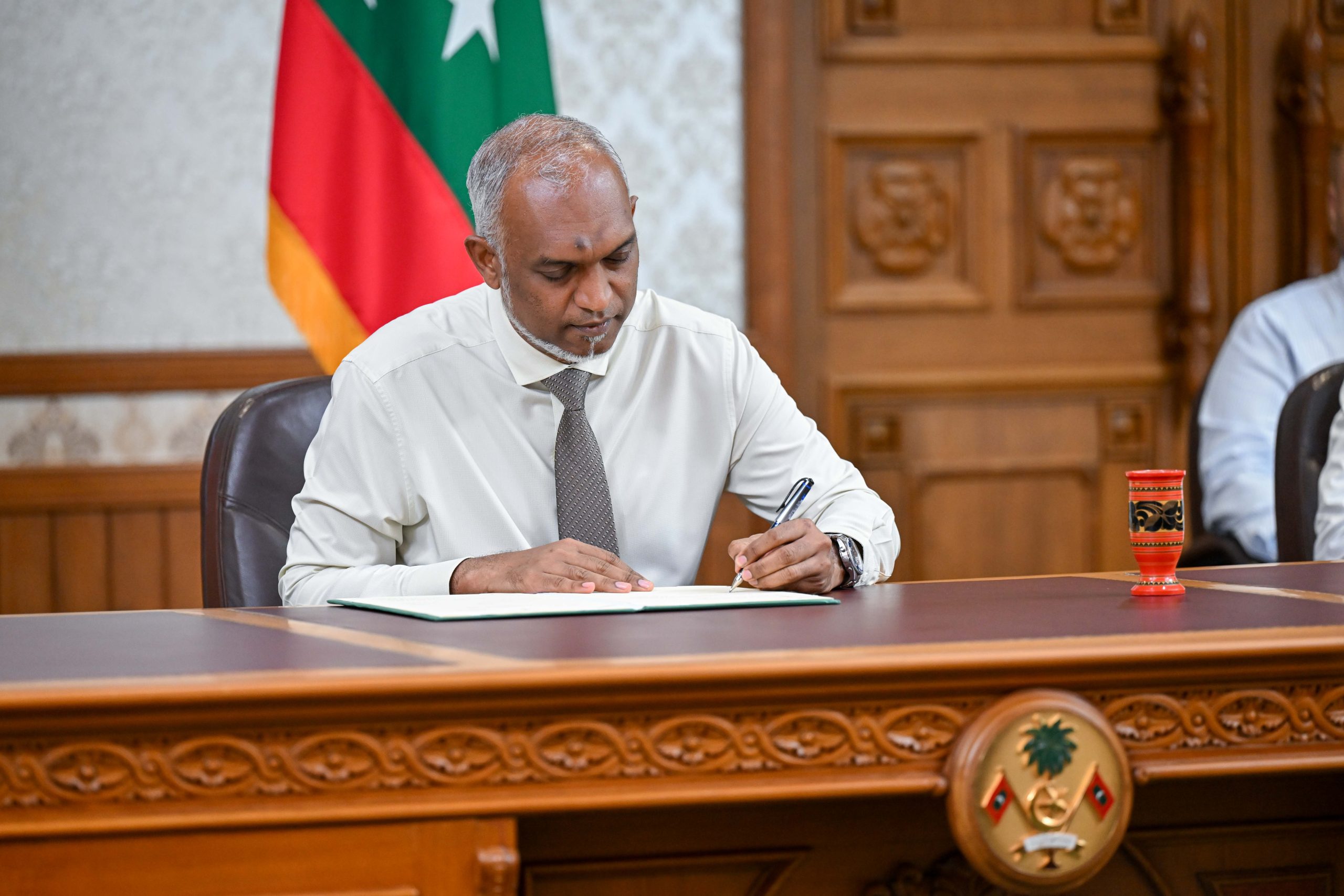

President Dr Mohamed Muizzu has assured tourism industry stakeholders that the newly ratified amendments to the Foreign Exchange Act have been structured to protect the operational and financial stability of resort properties while strengthening the Maldives’ foreign currency position and supporting the wider national economy.
Speaking after ratifying the government-sponsored amendments, President Muizzu said the revised foreign exchange framework was developed following extensive academic, statistical and technical assessments undertaken with the involvement of industry experts. He stressed that the requirements introduced under the legislation were determined after evaluating the financial structures, revenue patterns and expenditure obligations of tourism establishments operating across the Maldives.
The assurance is particularly significant for the Maldivian resort industry, which remains the country’s principal economic sector and the foundation of its international tourism profile. Resorts across the archipelago operate complex businesses involving substantial expenditure on staff salaries, imported goods, utilities, transportation, property maintenance, infrastructure development, financing obligations and a broad range of international services. The President maintained that these operational realities were taken into consideration when determining the revised foreign exchange requirement.
Under the previous regulatory framework, tourism establishments were required to exchange either USD 500 per month for every tourist arrival or 20 percent of their total revenue. The amended legislation introduces a revised mechanism for Category-A tourism establishments, requiring them to convert 40 percent of their total monthly foreign currency revenue into Maldivian Rufiyaa.
Addressing concerns over the potential impact of the revised requirement on resort businesses, President Muizzu said comprehensive financial and statistical assessments demonstrate that the 40 percent threshold is sustainable without compromising the ability of resorts to meet their operational commitments.
“The numbers show that this is not something that will cause difficulty to any resort. After deducting loans, salaries, and expenses, they can pay 40 percent in dollars. This is being done for the good and benefit of the citizens,” President Muizzu said.
The President’s remarks are intended to provide greater confidence to resort owners, operators and investors that the revised policy has been designed with the financial realities of the hospitality industry in mind. By allowing resort businesses to account for major obligations such as loan repayments, salaries and operating expenses, the government expects tourism establishments to continue maintaining service standards, property operations and long-term investment programmes while contributing more effectively to the domestic foreign exchange market.
Maldives’ resort industry has developed into one of the world’s most recognised premium tourism sectors, supported by internationally renowned hotel brands, locally established hospitality groups and continued private-sector investment. Resort developments generate employment, create business opportunities for local suppliers and service providers, support domestic transportation networks and contribute substantially to government revenue. Maintaining the operational strength and international competitiveness of these properties therefore remains closely connected to the country’s overall economic performance.
President Muizzu highlighted the substantial foreign currency earnings generated by tourism when explaining the economic rationale behind the amendments. He said the tourism industry generated approximately USD 5.6 billion last year, while around USD 3.8 billion entered the domestic banking system. However, only 21 percent of the USD 3.8 billion was exchanged through banks.
The President also noted that under the previous arrangement, the overall foreign currency exchange level had remained at around 10 percent, limiting the amount of foreign currency available through official domestic channels despite the significant dollar earnings generated by the tourism economy.
The revised framework is expected to increase the circulation of foreign currency within the domestic banking system, supporting greater availability of US dollars for businesses, public requirements and the importation of essential commodities. For an island economy heavily dependent on imported goods, improving access to foreign currency remains an important element of maintaining economic stability and ensuring continuity in the supply of essential products.
President Muizzu urged resort operators to recognise their participation in the revised system as part of a broader national responsibility, noting that the additional foreign currency entering the official financial system would directly benefit the public. He explained that increased foreign currency availability would assist in facilitating Telegraphic Transfers required for the importation of essential goods and other priority requirements of the country.
The government views the revised Foreign Exchange Act as part of its broader economic policy aimed at ensuring that a greater proportion of the foreign currency generated within the Maldives contributes directly to domestic economic activity. The policy also seeks to improve the efficiency of the formal foreign exchange market while enhancing the government’s ability to meet essential international payment requirements.
For the tourism sector, the government’s assurance that resort operating expenses, salaries and financing commitments have been carefully considered provides an important indication that the policy is intended to balance national foreign exchange requirements with the continued strength of the hospitality industry. The administration has emphasised that the objective is not to constrain resort operations, but to establish a sustainable mechanism through which the country’s largest foreign currency-earning sector can contribute more directly to national economic stability.
As the Maldives continues to attract international hospitality investment and expand its tourism portfolio, maintaining confidence among resort operators, investors and global hotel brands remains central to the sector’s long-term development. The government’s position is that stronger domestic foreign currency circulation and a financially sustainable tourism industry can progress together, supporting both continued resort development and wider economic resilience.
President Muizzu reiterated that the principal objective of the amended Foreign Exchange Act is to strengthen public service delivery, improve access to essential foreign currency requirements and create positive economic outcomes for Maldivian citizens, while ensuring that the tourism sector continues to operate as a strong and internationally competitive pillar of the national economy.
 advertisment




 advertisment