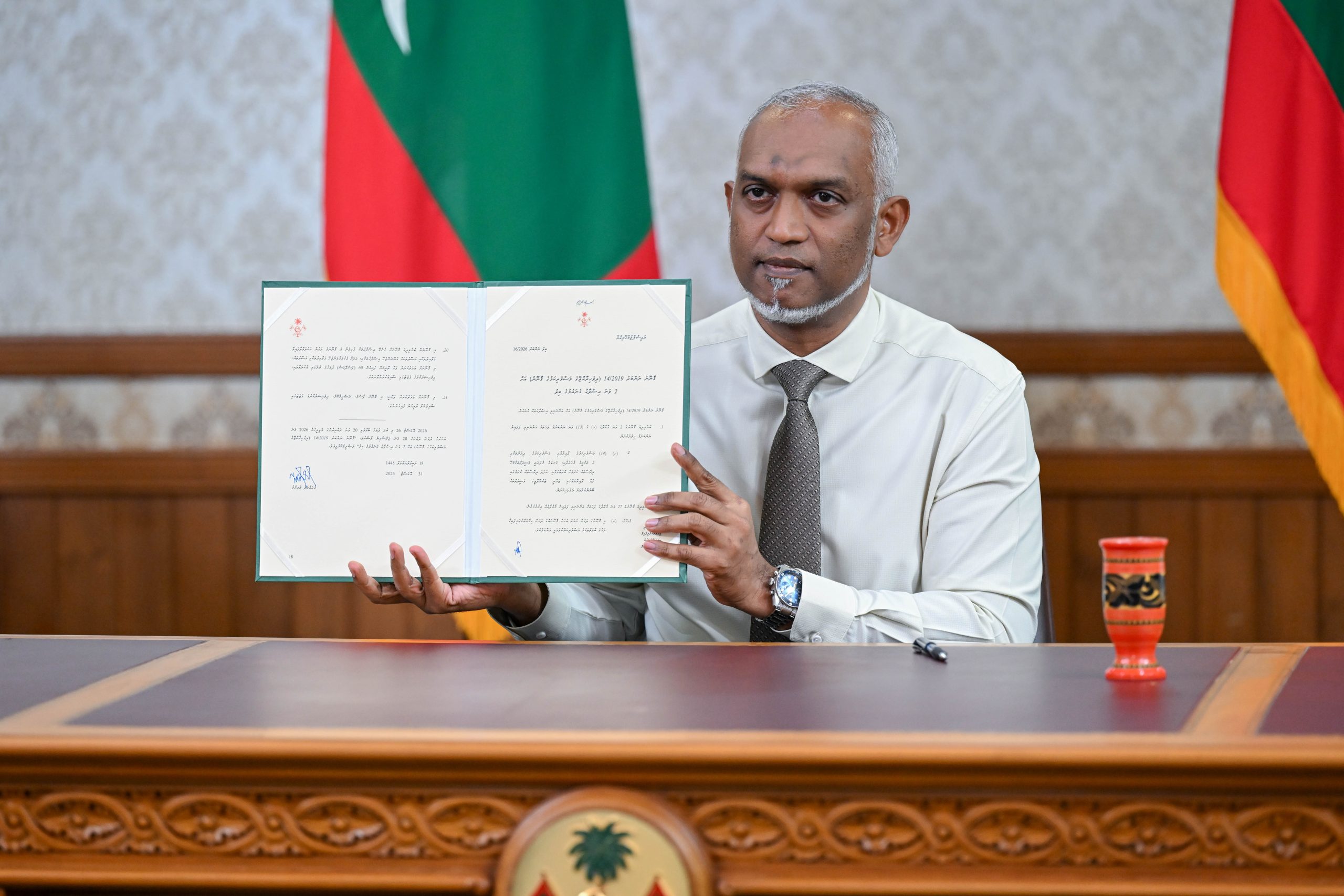

President Dr Mohamed Muizzu has ratified amendments to the Goods and Services Tax Act, introducing mandatory GST collection from offshore booking platforms, foreign tour operators and travel agents supplying tourism-related products and services connected to the Maldives. The amendments were ratified at a special ceremony held at the President’s Office on Tuesday as part of the Government’s broader efforts to strengthen the national tax framework and improve revenue collection from economic activities linked to the country.
The amendments establish a clearer framework for applying the destination principle within the Maldives’ GST system, ensuring that goods and services consumed or effectively supplied in the Maldives are appropriately brought within the domestic tax regime. This is particularly significant for the tourism industry, where a substantial volume of bookings and travel-related transactions involving Maldivian resorts, hotels, guesthouses and other tourism businesses are facilitated through overseas tour operators, travel agencies and online booking platforms.
Under the revised provisions, services provided from a place where a business operates in the Maldives will be regarded as services supplied within the country. The same principle will apply where the practical activities required to provide a service are carried out by a party in the Maldives, even when the recipient of the service is an entity that is not registered or permanently established in the country.
Services directly connected to immovable property located in the Maldives will also be regarded as services supplied domestically. This provision is particularly relevant to the tourism and hospitality sector, where accommodation establishments and tourism infrastructure are physically located within Maldivian territory even when bookings, payments or contractual arrangements are processed through businesses operating overseas.
The amendments further make GST applicable to inbound tourism products supplied in the Maldives regardless of whether the business conducting the taxable activity maintains a permanent place of business in the country. Inbound tourism products are defined to include tourism-related activities undertaken in the Maldives, including accommodation, food and transportation services.
The revised framework is expected to strengthen the treatment of tourism transactions involving foreign intermediaries and provide greater consistency between domestic tourism businesses and overseas entities benefiting commercially from the Maldives tourism market. The changes also reflect the increasing role of international booking platforms, tour operators and travel agents in connecting travellers with the country’s tourism properties and services.
The Maldives has developed one of the world’s most internationally recognised tourism industries, supported by a diverse portfolio of luxury resorts, hotels, guesthouses, liveaboards and other hospitality establishments distributed across the country’s island destinations. A significant proportion of international visitors arrange their holidays through overseas travel companies and digital booking platforms, making the taxation of cross-border tourism transactions an increasingly important component of the country’s revenue framework.
By expanding GST obligations to relevant foreign tourism businesses without a permanent establishment in the Maldives, the Government aims to ensure that commercial activities generating value from Maldivian tourism are treated more consistently under the national tax system. The framework is also expected to support a more transparent and sustainable revenue model as the tourism industry continues to expand and diversify across international markets.
The Government said the amendments are intended to address practical difficulties experienced in implementing the existing GST system while further strengthening tax administration. Clearer rules governing where services are considered to have been supplied are expected to reduce uncertainty surrounding cross-border transactions and support more effective implementation of GST requirements.
The Government has also submitted projections on the additional revenue expected to be generated through the amendments. According to the estimates, collecting GST from offshore booking platforms, foreign tour operators and travel agents that do not maintain a permanent place of business in the Maldives is expected to increase State revenue by approximately USD 103.8 million annually.
The projected additional revenue represents a significant contribution to public finances and supports the Government’s efforts to strengthen domestic revenue mobilisation while ensuring that economic value generated through the Maldives’ globally competitive tourism industry contributes appropriately to the national economy.
The amendments form part of the Muizzu Administration’s continued efforts to strengthen fiscal management, modernise the taxation framework and improve the efficiency of revenue collection. By extending tax obligations to overseas businesses participating in the Maldivian tourism economy, the Government is seeking to establish a more comprehensive tax base while maintaining the Maldives’ position as one of the world’s leading tourism destinations.
 advertisment




 advertisment