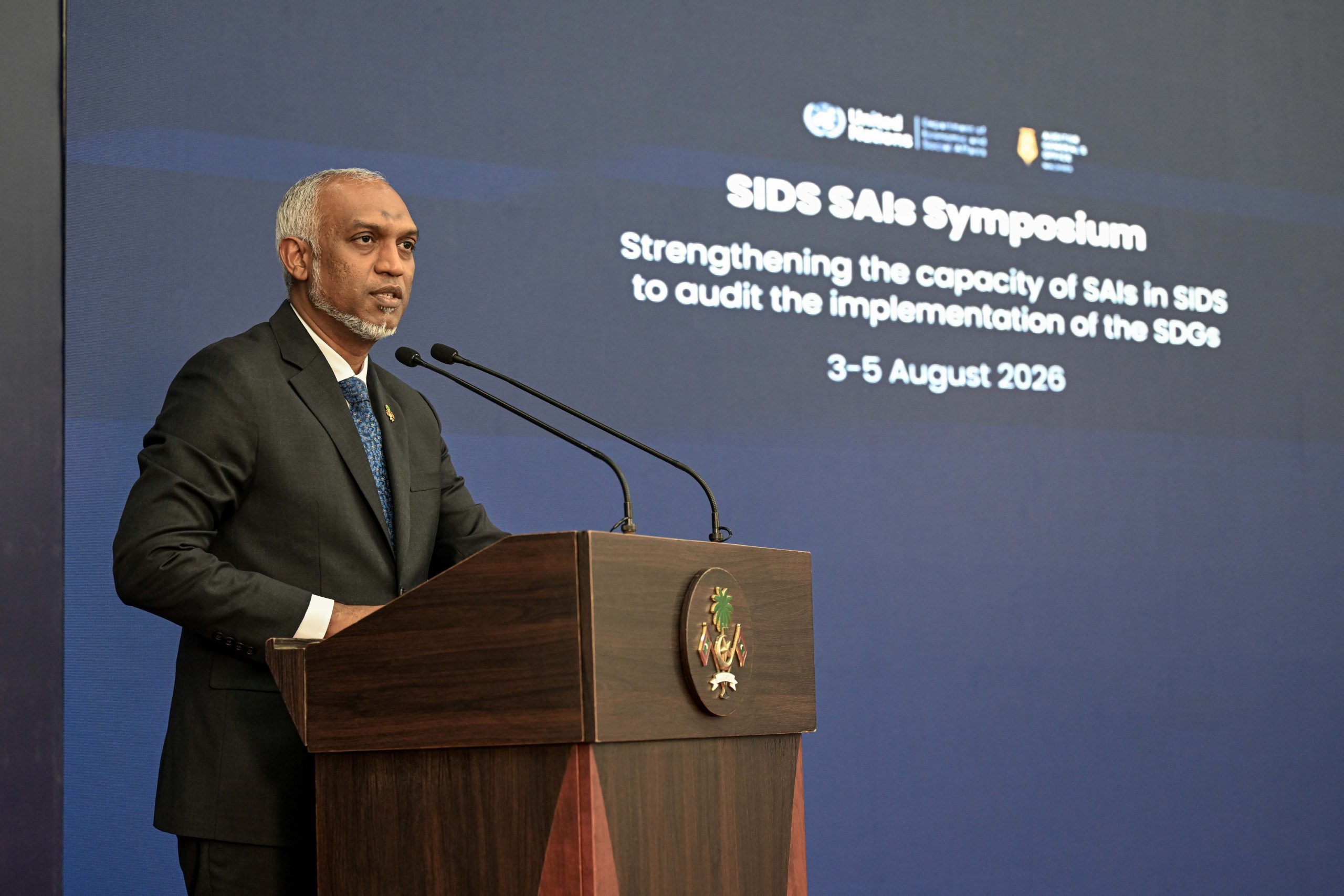

President Dr Mohamed Muizzu has called for sustained investment in integrity, accountability, transparency, innovation and meaningful international partnership, stressing that these principles are essential to building resilient states, strengthening democratic institutions, supporting healthier economies and creating more hopeful societies for future generations.
The President made the remarks while addressing the closing session of the Small Island Developing States Supreme Audit Institutions Symposium and the opening of the INTOSAI Development Initiative Global Summit. The high-level gathering brought together representatives of Supreme Audit Institutions from Small Island Developing States to exchange knowledge, strengthen professional capacity and enhance institutional contributions towards the implementation of the Sustainable Development Goals.
President Muizzu stated that genuine national resilience must be built upon strong and trusted institutions, supported by responsible fiscal management, transparent governance and sustained public confidence. He emphasised that Supreme Audit Institutions have an increasingly important responsibility in ensuring that public resources are managed effectively, national priorities are implemented responsibly and governments remain accountable to their citizens.
The President noted that every dollar entrusted to governments by citizens, as well as every dollar provided by international development partners, must be utilised for its intended purpose and deliver measurable public value. He described accountability not merely as an administrative responsibility, but as a strategic national asset that strengthens institutions, promotes confidence and supports sustainable economic and social progress.
Highlighting the distinct circumstances of Small Island Developing States, President Muizzu observed that these nations must frequently balance investment in long-term development with responsible debt management, respond to emergencies while preserving economic stability, protect vulnerable communities and simultaneously sustain growth. He said these challenges require strong financial oversight, effective institutions and innovative approaches to public administration.
Despite continuing global economic uncertainty and external pressures, the President reaffirmed that the Maldives remains committed to honouring its financial obligations while investing in national development and the future prosperity of its people. The Government’s approach reflects its commitment to strengthening fiscal responsibility, improving institutional performance and ensuring that development initiatives continue to support citizens and communities across the country.
Addressing the future of governance, President Muizzu said digital transformation provides Small Island Developing States with an unprecedented opportunity to overcome structural limitations arising from geography, distance and limited institutional capacity. He highlighted the Maldives 2.0 vision as the Government’s commitment to establishing a modern, efficient and citizen-centred digital state.
The President explained that technology should not be viewed solely as an innovation priority, but as an essential component of governance, development and national resilience. Through digital transformation, governments can improve public service delivery, strengthen transparency, enhance financial oversight, increase administrative efficiency and provide citizens with more accessible and responsive services.
During the ceremony, President Muizzu also officially launched the Auditor General’s Office of Maldives Strategic Plan 2026–2029. The plan is expected to guide the institution’s work in strengthening public-sector accountability, improving audit effectiveness, developing professional capacity and supporting the responsible management of public resources over the coming years.
The symposium was held in Ukulhas, North Ari Atoll, an island widely recognised for its commitment to environmental sustainability and responsible community development. With its well-maintained natural surroundings, clear waters and strong local environmental practices, Ukulhas provided a fitting setting for discussions on resilience, sustainable development and institutional responsibility.
The selection of Ukulhas also highlighted the important role played by island communities in advancing the Maldives’ national sustainability objectives. The island’s reputation for environmental awareness and community-led initiatives reflects the wider potential of Maldivian islands to contribute to sustainable tourism, responsible development and long-term environmental protection.
The gathering reinforced the Maldives’ position as an active advocate for the interests of Small Island Developing States and demonstrated the Government’s commitment to strengthening international cooperation, institutional accountability and sustainable governance. By hosting senior audit professionals and development partners, the Maldives provided an important platform for exchanging experience and developing practical solutions to the shared economic, environmental and administrative challenges faced by island nations.
 advertisment



 advertisment