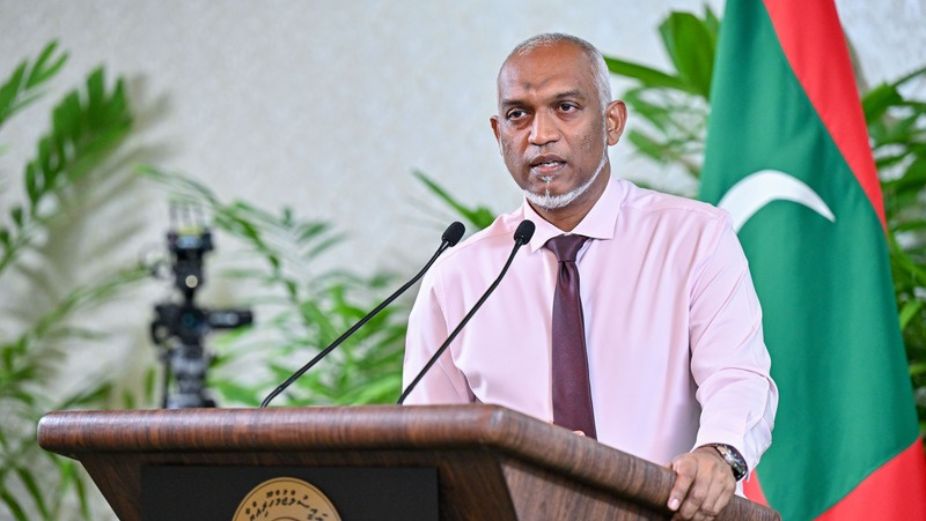

President Dr Mohamed Muizzu has said that the Bank of Maldives (BML) has indicated it will significantly ease restrictions on monthly foreign transactions towards the end of this month, offering reassurance to customers who have been affected by recent controls on overseas spending. The anticipated relaxation is expected to bring welcome relief to individuals relying on BML debit cards for international purchases, particularly as current limits have disrupted a wide range of routine transactions, including low-value payments on foreign websites.
The President made the remarks during the President’s Office weekly press conference, where he addressed concerns over the existing restrictions and the challenges faced by cardholders. He explained that the current controls were linked to foreign currency constraints faced by the bank, adding that recent discussions had produced a positive indication from BML that the limits would be eased substantially by the end of the month. His comments come at a time when many customers have been closely monitoring policy changes affecting overseas spending, amid growing dependence on digital platforms for shopping, travel arrangements, and essential international services.
BML’s foreign transaction controls have been the subject of considerable public attention in recent months. The bank had initially introduced a monthly overseas payment limit of USD 250 for debit cards, which was later increased to USD 500. However, this framework was subsequently revised and replaced with a more specific set of caps across all debit cards, creating a tighter and more structured system of controls for foreign usage. These measures have affected spending abroad through point-of-sale terminals and ATMs, with card usage restricted to individuals who are physically outside the Maldives. The bank introduced the policy as part of efforts to better regulate foreign currency usage and address concerns over misuse of debit cards, including reports of cards being rented out to travellers.
In addition to these controls, BML has also imposed a 30 per cent fee on selected overseas e-commerce platforms, including Temu, Shein, Alibaba, AliExpress, Lazada, and eBay. The bank said the fee was introduced in response to high foreign currency outflows associated with purchases made through such platforms. The decision underscored the pressure being placed on available foreign exchange resources as international online shopping continues to expand among local consumers. For many customers, the combined effect of transaction limits and platform-specific charges has highlighted the broader balancing act facing the banking sector as it seeks to support consumer demand while protecting national foreign currency reserves.
Previous policy updates announced in September last year had presented a more flexible framework, with higher overseas spending thresholds that included up to USD 1,000 for general foreign purchases and up to USD 3,000 for airline tickets, accommodation, and overseas medical payments. Those thresholds had reflected an effort to prioritise essential international expenses while still allowing customers broader access to overseas services. The latest indication that restrictions may be eased again by the end of this month is therefore likely to be seen as an encouraging development for individuals and families managing travel, education, healthcare, and online commercial transactions abroad.
The government has maintained that these measures are being driven by wider foreign currency pressures and increased demand for online transactions, rather than any structural weakness in the economy. This position reflects the administration’s broader effort to frame the restrictions as a targeted response to shifts in spending behaviour and foreign exchange demand. In this context, BML continues to manage allocations across essential and non-essential spending channels, seeking to maintain stability while ensuring that priority areas such as travel, medical needs, and other necessary foreign payments remain supported.
As the country’s leading financial institution, BML plays a central role in enabling both domestic banking services and international payment access for individuals and businesses. Any easing of the current foreign transaction restrictions is therefore likely to have a meaningful impact not only on everyday consumers, but also on confidence surrounding the accessibility and reliability of cross-border payment services. President Muizzu’s remarks signal a more positive outlook for customers awaiting greater flexibility, while also reflecting ongoing coordination between the government and the bank to respond to market realities in a measured and practical manner.
With the end of the month now approaching, attention is expected to turn to how BML will implement the anticipated changes and whether the revised limits will restore smoother access to foreign transactions for the public. For customers who have faced inconvenience in recent months, the development is likely to be welcomed as a constructive step towards improving payment access while continuing to manage foreign currency resources responsibly.
 advertisment




 advertisment