
In the Maldives, energy is far more than a basic utility. It remains one of the country’s most persistent structural challenges, shaped by geography, logistics, and economic exposure. Each island functions as an independent grid, with most electricity still generated through imported diesel. Without an inter-island electricity network, fuel must be shipped, stored, and consumed locally, creating a costly system that is highly sensitive to international oil price volatility. For a nation whose economy is closely tied to tourism and connectivity, this dependence continues to place considerable pressure on national expenditure and long-term energy planning.
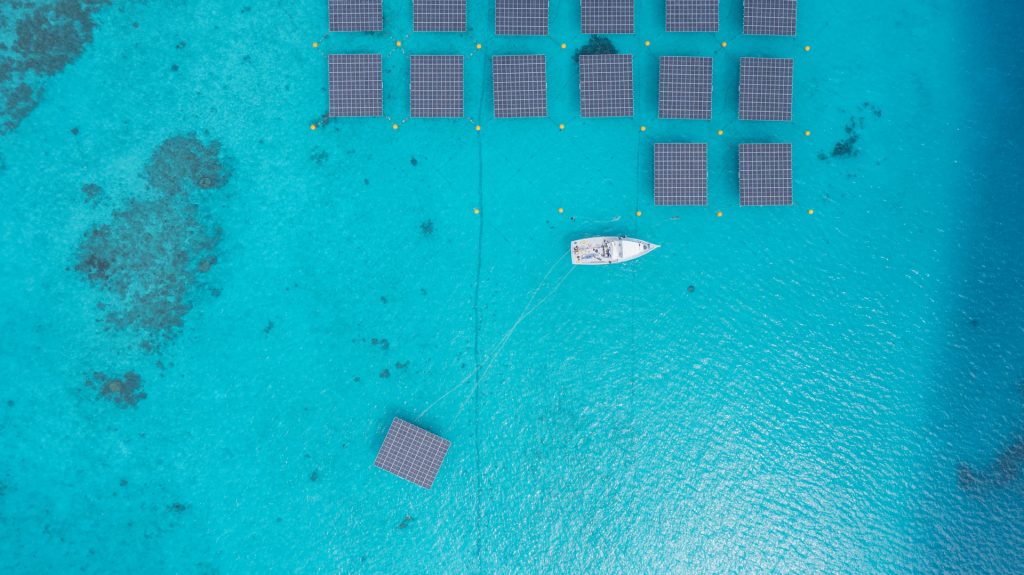
Against this backdrop, Cheval Blanc Randheli is demonstrating how innovation can help redefine energy use in island destinations. The resort has introduced a large-scale floating solar installation that now powers operations during daylight hours, marking an important step in the Maldives’ wider renewable energy transition. Developed by Swimsol, the 2.4 MW SolarSea® system is among the most advanced renewable energy installations currently in operation in the country and highlights how luxury hospitality can align operational excellence with environmental responsibility.
Set in the pristine Noonu Atoll, Cheval Blanc Randheli is widely recognised for its refined design, exceptional guest experience, and careful integration with the surrounding natural environment. The resort’s adoption of floating solar technology reflects a forward-looking approach that complements its identity as a high-end destination committed to quality, innovation, and sustainability. In a setting where service consistency, comfort, and uninterrupted operations are essential, the ability to integrate renewable energy without compromising guest experience is especially significant.
The installation at Randheli addresses one of the central constraints faced by small island states: land scarcity. Less than one per cent of the Maldives’ total territory is available for development, making conventional utility-scale solar projects difficult to implement without competing with essential infrastructure or affecting the visual and spatial character of resort islands. For premium destinations such as Cheval Blanc Randheli, where space planning, privacy, and aesthetics are central to the guest offering, such limitations are even more pronounced.
Floating solar presents a practical and highly relevant solution to this challenge. By placing photovoltaic systems offshore on the lagoon, Swimsol’s SolarSea® technology allows resorts to generate clean energy at scale without occupying valuable land. This offshore approach enables resort operators to expand renewable energy capacity while preserving the island environment and maintaining operational efficiency. At Cheval Blanc Randheli, the system is expected to generate annual diesel savings of approximately USD 1.5 million, underlining the growing economic value of renewable energy as global fuel costs remain unpredictable.
The project also reflects how renewable technology in the Maldives has matured over time. Earlier phases of solar adoption in the country focused primarily on rooftop systems, followed by hybrid models combining solar with diesel-based generation. Floating solar now represents the next stage of that evolution, offering a scalable solution capable of meeting the demanding reliability standards of luxury resort operations. For hospitality operators, uninterrupted power is non-negotiable, and renewable systems must function seamlessly within existing infrastructure. The successful integration at Randheli demonstrates that this balance is increasingly achievable.
Concerns that once limited broader adoption of solar technologies in island environments are gradually giving way to confidence built on performance and proven results. Swimsol reports that more than 50 resort islands across the Maldives now operate with its solar systems, including internationally recognised properties under brands such as Four Seasons Hotels and Resorts, Waldorf Astoria Hotels & Resorts, One&Only Resorts, and The Ritz-Carlton. What began as cautious testing has developed into wider industry acceptance, supported by reliable operation and carefully managed integration in some of the country’s most demanding hospitality settings.
The significance of this development extends beyond a single resort. The Maldives has increasingly emerged as a valuable testing ground for renewable energy solutions suited to isolated island environments. Since launching its first offshore floating solar platform in 2014, Swimsol has expanded its work across multiple island locations, with the majority of installations concentrated in Maldivian waters. The company reports a total installed capacity of 50 MWp, contributing to a gradual but meaningful shift in the country’s energy mix and offering a model that may hold lessons for other island nations facing similar challenges.
Even so, the scale of the national energy challenge remains substantial. More than 90 per cent of the Maldives’ installed generation capacity, estimated at around 600 MW, still depends on diesel. Reducing that dependence requires technologies that are not only sustainable, but also practical within the geographic and logistical realities of dispersed island systems. Floating solar is increasingly being viewed as one of the most promising answers, offering a combination of economic viability, operational reliability, and environmental benefit.
At Cheval Blanc Randheli, this balance is already being put into practice. Resort operations continue without interruption, while daytime electricity demand is increasingly met through renewable generation. The SolarSea® system functions as part of a hybrid model, reducing reliance on fossil fuels while preserving the level of consistency expected at a world-class resort. In the luxury hospitality sector, where guest satisfaction depends on every detail functioning smoothly, the ability to decarbonise operations without disrupting service is especially important.
For the Maldives, the broader message is clear. As fuel markets continue to fluctuate, long-term energy stability is becoming a strategic priority for both the tourism sector and the wider economy. Renewable systems capable of delivering more predictable energy costs over extended periods, in this case up to 30 years, offer a degree of certainty that diesel-based generation cannot provide. That certainty is particularly valuable in a country where environmental preservation and economic resilience are closely interconnected.
The transition to renewable energy in the Maldives is therefore more than an operational adjustment. It is becoming a defining feature of how the country plans for its future. In a nation where the natural environment is both the foundation of its tourism success and one of its most vulnerable assets, investments in clean energy carry significance far beyond cost savings alone. They speak to resilience, innovation, and a stronger alignment between development and environmental stewardship.
Floating solar, once regarded as an experimental concept, is now establishing itself as a practical part of that future. At Cheval Blanc Randheli, its successful deployment offers a strong example of how the Maldives can continue to lead in adapting advanced renewable solutions to island realities, reshaping how energy is produced, managed, and sustained across one of the world’s most distinctive destination markets.
 advertisment



 advertisment