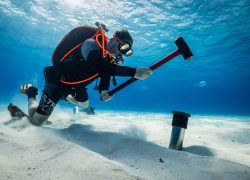
At the Fourth International Conference on Financing for Development (FfD4) held in Seville, Spain from June 30 to July 3, 2025, His Excellency Vice President Hussain Mohamed Latheef reaffirmed the Maldives’ strong commitment to sustainable development by highlighting the urgent need for increased investment in ocean health. Speaking at the Maldives Side Event titled “Blended Finance Opportunities for Marine Biodiversity: Case Studies on Coral Reef Insurance and Blue Economy Financing,” the Vice President addressed international delegates, development partners, and financial experts on the critical intersection of marine conservation, economic resilience, and climate adaptation.
The Vice President drew attention to the increasing threats facing ocean ecosystems, especially in Small Island Developing States (SIDS) such as the Maldives, where the ocean is not only a vital food source but also the cornerstone of its economy. He underscored that the Maldivian tourism industry, a key economic driver contributing over 21% to the national GDP and generating more than 60% of foreign exchange earnings, depends directly on the country’s rich marine biodiversity, particularly its vibrant coral reef systems.
However, the Vice President expressed deep concern over the rising frequency of mass coral bleaching events caused by global warming and ocean acidification. He emphasized that Sustainable Development Goal 14 – Life Below Water – continues to be one of the most underfunded global goals, and called the lack of ocean-targeted investment both “unacceptable and unsustainable.”
In response to this critical gap, he officially announced the launch of the Maldives’ Coral Reef Insurance initiative, a pioneering instrument designed to bridge the ocean finance gap by pricing climate-related risk, protecting marine ecosystems, and creating financial buffers for communities dependent on the sea. The initiative is structured as a blended finance model that combines public and private capital to support climate resilience in marine-based sectors.
The Coral Reef Insurance scheme is also expected to empower micro, small, and medium-sized enterprises (MSMEs) in the blue economy, facilitating their access to much-needed capital. By de-risking lending and building the financial and managerial capacity of ocean-focused businesses, the initiative aims to develop a robust pipeline of investable projects that are both environmentally sustainable and economically viable.
Addressing the broader financing landscape, the Vice President made a passionate appeal for reforming the global development finance system to meet the urgent needs of vulnerable island nations. He stated that access to development finance is not simply a development issue for SIDS, it is a matter of survival. With climate risks increasing in both scale and frequency, he called on international financial institutions and donor countries to rethink the structure of global financing to ensure equitable, timely, and needs-based support for countries on the frontlines of the climate crisis.
The FfD4 conference, attended by high-level delegates from governments, multilateral development banks, and the private sector, serves as a platform to address global financing challenges and explore innovative mechanisms to fund sustainable development. The Maldives’ participation, particularly through this dedicated side event, reaffirmed its leadership in advocating for ocean-based solutions and climate-resilient finance, while positioning the country as a model for how tourism, conservation, and climate adaptation can coexist through carefully designed financial instruments.
 advertisment



 advertisment