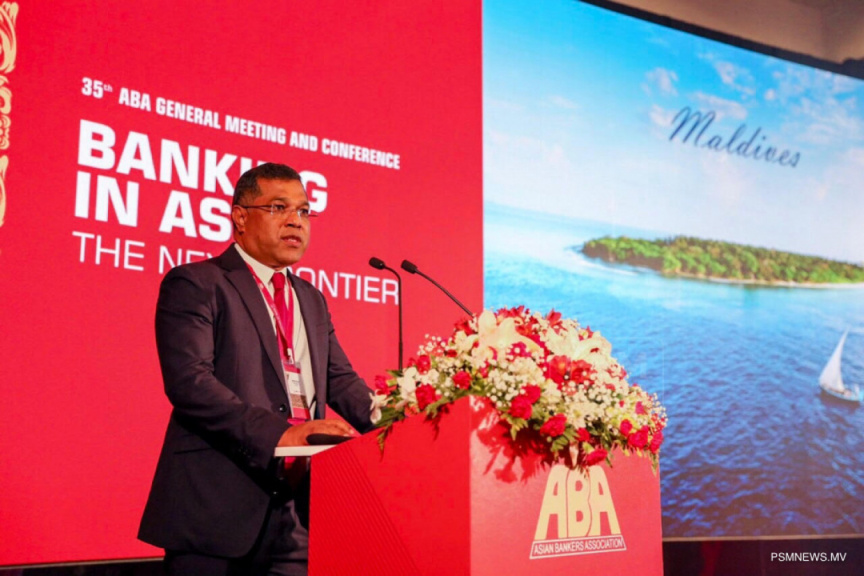

Chief Executive Officer and Managing Director of Bank of Maldives (BML), Mohamed Shareef, has stated that recent amendments to card limits have significantly increased overseas transactions conducted by the bank’s customers, with the total value reaching USD 524 million. He made the remarks while speaking at a ceremony held in Addu City to launch the bank’s digital wallet, SWIPE’, highlighting the growing role of modern banking services in supporting the evolving financial needs of Maldivians.
Addressing the gathering, Shareef explained that Bank of Maldives aims to deliver more than conventional banking services, noting that the institution continuously seeks opportunities to contribute to the nation’s broader economic progress. Reflecting on the bank’s establishment on November 11, 1982, he described the founding of the national bank as a significant point in the country’s development journey. At the time, Maldives had a limited and underdeveloped banking and financial sector, with most formal banking services being handled by foreign institutions and cash serving as the primary medium for financial transactions across the country.
Shareef noted that the creation of the national bank provided the Maldives with an institutional framework capable of supporting national economic growth and strengthening financial independence. Over the decades, Bank of Maldives has played a central role in expanding access to banking services across the country, encouraging the integration of cash into the formal banking system and providing financial support to critical sectors of the Maldivian economy, including tourism, fisheries, and other industries that drive national development.
The CEO also discussed the close relationship between the bank and the broader Maldivian economy, explaining that the performance of the financial sector is closely linked to the health of the national economy. He stated that economic challenges affecting the country also influence the operations of the banking sector, while improvements in economic performance contribute to stronger banking infrastructure and services.
Shareef acknowledged that one of the major economic challenges facing the Maldives is the shortage of US dollars, which also presents a significant challenge for the bank, particularly in maintaining services such as cross-border payments. He pointed out that limits on debit cards and Telegraphic Transfers (TT) have long been a concern among customers. As of September 2020, the overseas spending limit on individual debit cards had been set at USD 250, while only five percent of foreign currency was made available for Telegraphic Transfers. According to Shareef, the bank recognized that this arrangement was unsustainable, particularly considering the increasing foreign currency requirements of merchants, businesses, and individual customers.
He explained that the bank’s board and management therefore prioritized efforts to find sustainable solutions to address the issue. Through collaboration with the current administration and various policy measures, the bank was able to achieve meaningful progress in improving its foreign exchange position.
Shareef highlighted that President Dr Mohamed Muizzu’s decision to increase overseas spending limits for debit cards was made following government support aimed at addressing the bank’s foreign exchange short position. The revised card limits have since had a measurable impact on overseas transactions conducted by customers. According to the bank’s 2025 financial figures, combined overseas transactions carried out through ATMs, point-of-sale terminals, and e-commerce platforms reached USD 524 million. This represents an increase of USD 200 million compared to the previous year.
He added that the upward trend has continued into the current year, with customers conducting approximately USD 60 million in overseas transactions during January 2026 alone. The figures, he said, demonstrate the growing reliance on digital payments and the expanding role of Maldivian consumers and businesses in international commerce.
Concluding his remarks, Shareef stated that credit card limits are determined based on individual income levels and banking relationships, while the allocation of foreign currency for Telegraphic Transfers by businesses has also improved significantly. He noted that the proportion of US dollars released for business-related Telegraphic Transfers has now increased to between 30 percent and 50 percent. These changes, he said, are expected to benefit individuals, businesses, and the banking sector alike, while supporting the continued modernization of the Maldives’ financial ecosystem.
 advertisment




 advertisment